
Her special interest in shoulder care began with extensive academic research into shoulder impingement syndrome and rotator cuff dysfunction. Her work was among the earliest original studies of its kind conducted in the Southeast Asian region and was presented before an international scientific forum at the European Congress of Physical and Rehabilitation Medicine in Lisbon, Portugal.
Expert Rehabilitation & Shoulder Pain Specialist in Jaipur
The Shoulder Designed for Freedom Treated with Respect.
- Precision Shoulder Care
- Minimum Intervention
- Maximum Function
The shoulder is perhaps the most remarkable and dynamic joint in the human body. No other joint offers such extraordinary freedom of movement allowing the arm to reach, rotate, lift and move through an almost 360-degree arc.
This remarkable mobility comes at the cost of inherent stability.The shoulder’s ball rests within a naturally shallow socket. Its stability depends upon an exquisitely coordinated system: the labrum deepens the socket, the rotator cuff tendons centre the humeral head, and the muscles of the scapula, thorax and cervical spine work together to guide every movement. The shoulder is therefore not an isolated joint it is part of a sophisticated kinetic system connecting the arm, shoulder blade, chest and neck.
Dr. Aayushi Choudhary
- MBBS
- MD (Physical Medicine & Rehabilitation) – Gold Medalist
- Fellowship in Interventional Pain Management (FIPM)
- Musculoskeletal Ultrasound (MSK USG – USPRM), Lisbon, Portugal
- President's Award 2022 European Society of Physical & Rehabilitation Medicine
Expert Rehabilitation & Shoulder Pain Specialist Doctor in Jaipur
Preserve the Movement Before You Alter the Joint
Yet, in just a few decades, the way we live has changed dramatically
At Purple Heron Hospital, our philosophy is simple: a joint designed for extraordinary movement must be treated with extraordinary precision.
Even procedures commonly described as “minor,” including arthroscopy, are not biologically neutral. Entering the joint requires surgical portals and initiates a healing response; in selected patients, postoperative scar formation, stiffness and altered mechanics may follow. Surgery certainly has an important role when structurally necessary but it should follow accurate diagnosis and clear clinical indication, not become the automatic first response to every painful shoulder.
In most young and active patients, the first and most determined effort should be directed towards preserving the natural shoulder through precise diagnosis, image-guided minimum interventions, evidence led regenerative medicine and comprehensive rehabilitation.
The objective is not merely to reduce pain. It is to restore rotator cuff integrity, recover scapular rhythm, protect the cervical spine and preserve the effortless freedom with which the shoulder was originally designed to move.
A Philosophy Shaped by Original Research
Dr. Aayushi Chaudhary’s approach to shoulder preservation is grounded in extensive academic and clinical work in shoulder impingement syndrome and rotator cuff injuries. Her original research among the first of its kind from Southeast Asia—was presented internationally at the European Society of Physical and Rehabilitation Medicine Congress in Lisbon, Portugal.
That research continues to define her clinical philosophy today
Diagnose the complete biomechanical problem. Intervene with precision. Regenerate where appropriate. Rehabilitate comprehensively. Preserve the natural joint whenever possible.
A Special Interest Shaped by Research
Understanding the Shoulder Beyond Pain
Dr. Aayushi Chaudhary, the shoulder has always represented far more than a painful joint. Its extraordinary range of motion, delicate stability and intricate relationship with the rotator cuff, scapula, thorax and cervical spine make it one of the most biomechanically fascinating regions of the human body.
As an MD (PMR) Gold Medalist, avid researcher and Pain & Musculoskeletal Medicine Specialist, Dr. Aayushi has continued to study the shoulder not merely through imaging or isolated structural abnormalities, but through its complete biomechanics—how the humeral head remains centred, how the rotator cuff maintains dynamic stability, how the scapula moves over the thorax, and how the cervical spine influences shoulder function.
This research-led understanding forms the foundation of her shoulder practice today: identifying the precise structure responsible for pain, recognising the biomechanical disturbance behind it, and restoring movement through image-guided minimum interventions, evidence-led regenerative medicine and comprehensive rehabilitation.
Shoulder Intelligence
Understanding Shoulder Pain
Shoulder pain is a symptom, not a diagnosis. The source may be the joint, rotator cuff, bursa, capsule, labrum, ligaments, biceps tendon, AC joint, surrounding muscles, nerves—or even the cervical spine.
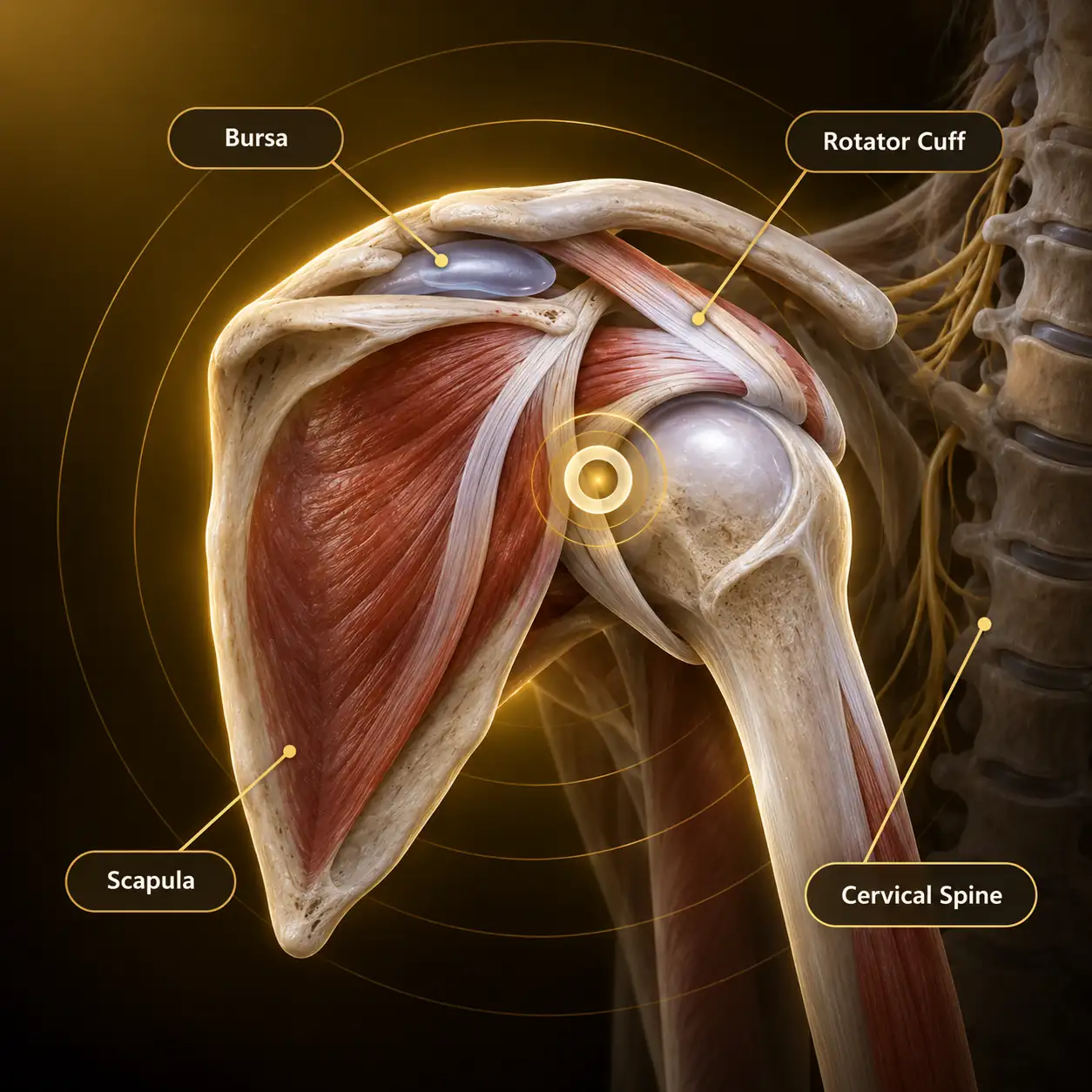
One symptom. Multiple possible sources.
Why imaging alone is not enough
Different shoulder conditions can produce remarkably similar symptoms. Pain while lifting, night pain, weakness, stiffness, clicking or restricted movement needs clinical and biomechanical correlation—not scan interpretation alone.
Assessment must examine
Location, nature & duration of pain
Active & passive range of movement
Rotator cuff strength & tendon integrity
Stability & previous dislocations
Scapular position & movement
Cervical spine & neurological function
Posture & thoracic mobility
Work, sport & overhead activities
Previous injuries, injections or surgery
Impact on sleep & everyday function
Function First
Our Goal in Treating Shoulder Pain
Not simply temporary pain suppression—restore movement, mechanics and long-term shoulder health.
Identify the precise source of pain
Control inflammation & protect vulnerable tissues
Restore comfortable shoulder movement
Recover rotator cuff & scapular strength
Re-establish normal shoulder biomechanics
Prevent compensatory neck & upper-back stress
Return safely to work, sport & daily activity
Preserve the natural shoulder & reduce recurrence
Know the Signs
When Should You See a Shoulder Pain Specialist?
Occasional soreness after unusual exertion may settle with rest. Persistent or progressive symptoms—especially those affecting sleep, strength, movement or daily activities—deserve proper evaluation.
Persistent or Recurrent Pain
Pain that continues despite rest or repeatedly returns with activity may signal a tendon, bursal, joint or biomechanical problem.
Night Pain
Pain that disturbs sleep or prevents lying on the affected side is commonly associated with rotator cuff pathology, bursitis, frozen shoulder or inflammation.
Progressive Stiffness
Difficulty reaching overhead, dressing, combing hair or reaching behind the back may suggest frozen shoulder, arthritis or capsular restriction.
Reduced Range of Movement
Inability to raise, rotate or move the arm normally should be assessed before compensatory movement patterns become established.
Shoulder Weakness
Difficulty lifting the arm, carrying objects or performing previously easy movements may indicate rotator cuff, tendon or nerve involvement.
Pain Following an Injury
Falls, sudden pulls, collisions, gym or sports injuries can be associated with tendon tears, labral injuries, instability, dislocation or fracture.
Slipping or “Giving Way”
A loose, shifting or “about to come out” feeling may indicate shoulder instability—even without a complete dislocation.
Previous or Recurrent Dislocation
Repeated dislocations can damage the labrum, capsule, ligaments or bone and require a detailed stability assessment.
Clicking, Catching or Locking
Painful mechanical symptoms with weakness or instability may arise from the labrum, biceps anchor, cartilage or altered mechanics.
Numbness, Tingling or Radiating Pain
Symptoms travelling down the arm can suggest cervical radiculopathy, nerve irritation or another neurological condition.
Visible Deformity or Abnormal Position
Contour change, a prominent shoulder blade, swelling, bruising or asymmetry after injury needs prompt assessment.
Pain Affecting Daily Function
Medical evaluation is appropriate when pain interferes with dressing, bathing, driving, sleeping, working, exercise or household activity.
Symptoms Not Improved With Previous Treatment
Persistent pain despite medication, physiotherapy, injections or previous surgery warrants a fresh cause-based evaluation of the shoulder, scapula, cervical spine and complete upper-limb biomechanics.
Cause-Based Care
Common Causes of Shoulder Pain
Shoulder pain can arise from several different tissues and movement systems. The 32 commonly encountered causes below are organised into six clinical groups to make a complex subject easier to understand—without reducing diagnosis to a scan alone.
32
Potential causes
to assess clinically
to assess clinically
A cause-based shoulder map
Same symptom. Different structure. Different treatment pathway.
Pain, stiffness, weakness, clicking and restricted movement often overlap across shoulder conditions. A careful examination helps identify whether the dominant problem is tendon, instability, joint, scapular mechanics, nerve or activity-related.
01 Symptoms→
02 Examination→
03 Correlation→
04 Cause-based plan
01 · Soft Tissue
Rotator Cuff, Tendon & Bursa
Common pain generators around the rotator cuff, subacromial bursa and long-head biceps tendon.
7 conditions
01Rotator Cuff TendinopathyOuter shoulder pain • overhead load • night pain+
The rotator cuff tendons may become irritated or structurally weakened due to repetitive overhead activity, altered biomechanics, age-related degeneration or excessive loading. Pain is commonly felt over the outer shoulder and may worsen while lifting the arm or sleeping on the affected side.
02Shoulder Impingement SyndromeCompression • scapular movement • elevation pain+
Impingement-related pain develops when the rotator cuff tendons and subacromial bursa become compressed or irritated during elevation of the arm. It is often associated with rotator cuff dysfunction, altered scapular movement and reduced subacromial space rather than being an isolated structural problem.
03Rotator Cuff TearPain • night discomfort • weakness+
A rotator cuff tendon may be partially or completely torn because of acute trauma or progressive degeneration. Patients may experience pain, night discomfort, weakness and difficulty lifting or controlling the arm, although the clinical importance of a tear must always be correlated with examination.
04Subacromial–Subdeltoid BursitisInflammation • overhead pain • tenderness+
The bursa is a fluid-filled structure that allows the rotator cuff to glide beneath the acromion. When inflamed, it can produce significant pain during overhead movement, night pain and tenderness around the outer shoulder.
05Calcific TendinitisCalcium deposits • inflammatory pain • restricted movement+
Calcium deposits may develop within the rotator cuff tendons, most commonly the supraspinatus. The condition can cause gradually increasing discomfort or an acute episode of severe inflammatory pain with profound limitation of movement.
06Long-Head Biceps TendinopathyFront shoulder pain • lifting • pulling+
Inflammation or degeneration of the long-head biceps tendon typically causes pain in the front of the shoulder. Symptoms may worsen with lifting, reaching backwards, pulling or repetitive overhead activity and frequently coexist with rotator cuff or labral pathology.
07Biceps Tendon Tear or InstabilitySudden pain • weakness • clicking+
The biceps tendon may partially tear, rupture or move abnormally within its groove. Patients may notice sudden pain, weakness, clicking or a visible “Popeye” bulge following complete rupture.
02 · Stability
Instability, Dislocation & Labrum
Conditions affecting the structures that keep the humeral head securely centred in the shoulder socket.
9 conditions
08Shoulder InstabilityLoose shoulder • trauma • repetitive overhead activity+
Shoulder instability occurs when the humeral head does not remain securely centred within the glenoid. It may follow trauma, develop after repeated overhead activity or arise because of generalised ligamentous laxity.
09Shoulder DislocationHumeral head leaves socket • urgent reduction+
A dislocation occurs when the humeral head completely leaves the socket, most commonly in the anterior direction. It may damage the capsule, labrum, ligaments, bone, rotator cuff or nearby nerves and requires prompt reduction followed by assessment of the resulting injury.
10Shoulder SubluxationPartial slipping • apprehension • weakness+
A subluxation is a partial or temporary slipping of the humeral head from the socket. It may produce pain, apprehension, weakness or a recurrent sensation that the shoulder is moving out of position.
11Recurrent Anterior InstabilityAfter anterior dislocation • recurrent slipping+
Following an anterior dislocation, injury to the anterior labrum and capsule may allow the shoulder to repeatedly dislocate or sublux. Young and active patients are particularly vulnerable to recurrence.
12Posterior Shoulder InstabilityDeep pain • weakness • pushing difficulty+
Posterior instability is less common and may follow trauma, seizures, electrical injury or repetitive loading in a forward-flexed position. Symptoms may be subtle and present as deep pain, weakness or difficulty with pushing activities.
13Multidirectional InstabilityExcess mobility • laxity • poor muscular control+
In multidirectional instability, the shoulder may be excessively mobile in more than one direction. It is often associated with ligamentous laxity, poor muscular control or repetitive activity and requires careful functional assessment.
14Labral TearDeep pain • catching • instability+
The labrum is the fibrocartilaginous rim that deepens the shoulder socket and contributes to stability. A tear may cause deep shoulder pain, catching, clicking, weakness or a sensation of instability.
15SLAP LesionUpper labrum • biceps anchor • overhead sport+
A SLAP lesion affects the upper part of the labrum where the long-head biceps tendon attaches. It may occur after a fall, forceful traction, dislocation, heavy lifting or repetitive overhead sports and can cause pain, mechanical symptoms and reduced performance.
16Bankart LesionAnterior-inferior labrum • recurrent dislocation+
A Bankart lesion is an injury to the front-lower part of the labrum, usually following an anterior shoulder dislocation. It may compromise stability and contribute to recurrent dislocation or apprehension during overhead movement.
03 · Joint & Bone
Joint, Arthritis, Trauma & Stiffness
Joint-surface, AC-joint, inflammatory, traumatic and post-surgical causes of pain and restricted movement.
7 conditions
17Frozen Shoulder / Adhesive CapsulitisProgressive pain • active & passive stiffness+
Frozen shoulder causes progressive pain and restriction of both active and passive shoulder movement. It may occur spontaneously or after injury, surgery or immobilisation and is more frequently associated with diabetes and thyroid disorders.
18Acromioclavicular (AC) Joint PainTop of shoulder • cross-body movement • loading+
The acromioclavicular, or AC, joint lies at the top of the shoulder where the collarbone meets the acromion. Arthritis, repetitive loading or injury can cause localised pain, particularly during cross-body movement, pressing exercises or overhead activity.
19AC Joint Sprain or SeparationDirect fall • swelling • visible prominence+
A direct fall onto the shoulder can stretch or tear the ligaments supporting the AC joint. The injury may produce pain, swelling and a visible prominence over the top of the shoulder.
20Glenohumeral OsteoarthritisDeep pain • stiffness • grinding+
Shoulder osteoarthritis develops when the cartilage covering the ball-and-socket joint progressively deteriorates. It may cause deep pain, stiffness, grinding and gradual loss of movement and function.
21Inflammatory ArthritisMorning stiffness • warmth • swelling+
Rheumatoid arthritis and other inflammatory conditions can affect the shoulder joint, bursae and tendons. Pain may be accompanied by prolonged morning stiffness, warmth, swelling or involvement of multiple joints.
22Fracture or Post-Traumatic Shoulder PainClavicle • proximal humerus • scapula+
Fractures involving the clavicle, proximal humerus or scapula may follow a fall or significant impact. Persistent pain after apparently minor trauma—especially in older adults—should be evaluated to exclude an occult fracture or associated soft-tissue injury.
23Post-Surgical Shoulder StiffnessCapsular stiffness • scar • weakness • altered mechanics+
Pain and restricted movement may persist or develop after shoulder surgery because of capsular stiffness, scar formation, weakness, altered scapular mechanics or incomplete rehabilitation. These patients require reassessment of the complete shoulder–scapular–cervical system.
04 · Movement Control
Scapula, Muscle & Biomechanics
Shoulder-blade mechanics and muscular factors that can change load distribution across the shoulder and neck.
3 conditions
24Scapular DyskinesisAltered shoulder-blade mechanics • muscle imbalance+
Scapular dyskinesis refers to altered position or movement of the shoulder blade during arm activity. It may develop because of weakness, pain, nerve dysfunction, posture or muscle imbalance and can increase mechanical stress on the rotator cuff and cervical region.
25Scapulothoracic Bursitis / Snapping ScapulaGrinding • snapping • scapular tenderness+
Inflammation or abnormal movement between the scapula and chest wall may cause pain, grinding, snapping or tenderness around the shoulder blade. Posture, muscle imbalance and bony abnormalities may contribute.
26Myofascial Shoulder PainTrigger points • muscular overload • referred pain+
Trigger points and muscular overload involving the trapezius, levator scapulae, pectoral muscles or posterior shoulder muscles can cause localised or referred pain. Underlying postural and biomechanical factors should be identified rather than treating muscular tenderness alone.
05 · Referred & Neurological
Neck, Nerve & Referred Pain
Pain that may originate from the cervical spine, peripheral nerves or, occasionally, outside the musculoskeletal system.
4 conditions
27Cervical Referred PainNeck source • shoulder-blade pain • posture+
Disorders of the cervical discs, facet joints or surrounding structures can refer pain into the shoulder or shoulder blade. Neck movement, posture and neurological examination help differentiate cervical pain from primary shoulder pathology.
28 Cervical RadiculopathyRadiating pain • tingling • numbness • weakness+
Compression or irritation of a cervical nerve root may cause pain travelling from the neck or shoulder into the arm, often accompanied by tingling, numbness, altered reflexes or weakness. Scapular pain may sometimes appear before symptoms extend further into the arm.
29 Nerve-Related Shoulder DysfunctionWeakness • wasting • abnormal scapular movement+
Involvement of the suprascapular, axillary, long thoracic, spinal accessory or dorsal scapular nerve may cause pain, weakness, muscle wasting or abnormal scapular movement. These conditions require focused neurological and musculoskeletal evaluation.
30 Referred Pain From Outside the Musculoskeletal SystemHeart • lungs • diaphragm • gallbladder+
Occasionally, pain perceived around the shoulder may originate from the heart, lungs, diaphragm, gallbladder or another internal organ. Shoulder pain associated with chest discomfort, breathlessness, sweating, abdominal symptoms, fever or unexplained systemic illness requires appropriate medical evaluation.
06 · Load & Activity
Sport, Work & Repetitive Overuse
Activity-related overload from sport, gym, overhead work, sustained posture or repetitive movement.
2 conditions
31 Sports-Related Shoulder InjurySwimming • badminton •cricket • weight training+
Swimming, badminton, tennis, cricket, volleyball, throwing sports, weight training and repetitive overhead exercise place substantial demands on the rotator cuff, labrum and scapular stabilisers. Injury may result from acute trauma, excessive loading, poor technique or inadequate recovery.
32 Occupational & Repetitive-Strain PainLifting •overhead work • computer posture+
Repeated lifting, overhead work, prolonged computer use and sustained postures can overload the shoulder and scapular muscles. Without correction of ergonomics and movement patterns, symptoms may continue despite temporary pain relief.
Precision Diagnosis
How We Diagnose the True Cause of Shoulder Pain
An MRI report is only one part of the picture. The real diagnosis comes from connecting pain, movement, strength, scapular mechanics, the cervical spine, nerves and imaging.
The Shoulder–Scapula–Spine Connection
Shoulder pain may begin in the shoulder, be influenced by the neck and nerves, or develop from a combined movement problem.
Shoulder
Joint, rotator cuff, biceps, bursa, capsule and labrum can be primary pain generators.
Scapula & Movement
Loss of scapular rhythm changes load distribution and can repeatedly overload tendons.
Cervical Spine & Nerves
Disc, facet or nerve-root problems may refer pain into the shoulder blade, shoulder or arm.
The key question is not only “Where does it hurt?” but “Where did the problem begin, what is
maintaining it, and what is now restricting normal movement?”
Our 12-Step Shoulder Evaluation
Grouped into four easy-to-understand clinical stages.
Stage 1 · Understand
01
Detailed Clinical HistoryOnset, injury, night pain, weakness, instability,
radiation, work and sport demands.
02
Inspection at RestPosture, asymmetry, scapular winging, wasting, swelling,
deformity and scars.
03
Palpation & MappingAC joint, biceps, cuff insertions, subacromial region, scapula
and cervical structures.
Stage 2 · Movement
04
Movement Through AnglesForward elevation, abduction, rotation, cross-body and
functional reaching.
05
Active vs Passive MotionHelps separate stiffness, pain inhibition, tendon
weakness and neurological dysfunction.
06
Scapulohumeral RhythmChecks winging, shoulder hiking, tilt, rotation and trunk or
neck compensation.
Stage 3 · Structure
07
Rotator Cuff TestingSupraspinatus, infraspinatus, teres minor and subscapularis
tested individually.
08
Pain-Provocation TestsAssesses cuff, biceps, AC joint, labrum, impingement,
capsule and instability patterns.
09
Stability ExaminationAnterior, posterior, inferior and multidirectional
instability plus apprehension.
Stage 4 · Whole System
10
Cervical & Neurological ExamNeck motion, nerve roots, sensation, power, reflexes,
grip and peripheral nerves.
11
Posture & Thoracic MobilityForward head, rounded shoulder, thoracic stiffness,
pectoral tightness and ergonomics.
12
Functional EvaluationDressing, lifting, driving, gym, swimming, throwing, racquet
sports and work tasks.
Diagnostic Tools Used Only When They Add Value
Imaging is selected according to the clinical question, not ordered automatically.
Dynamic MSK UltrasoundReal-time tendon, bursa, biceps and impingement assessment during
movement.
X-RayUseful for fracture, arthritis, calcification, joint-space changes and bony
alignment.
MRI / Laboratory TestsUsed when deeper structural, inflammatory, infectious or
surgical-planning questions remain.
Image-Guided Diagnostic BlockMay help identify the actual pain generator when more than one
abnormality is present.
Precision in treatment begins with precision in diagnosis we treat the complete functional
problem, not an isolated line on a scan report.
Shoulder Preservation
A Structured Treatment Pathway
Treatment should progress from the least invasive effective option to more advanced intervention only when clinically required. The aim is not to avoid surgery at any cost it is to use the smallest appropriate intervention capable of restoring meaningful function.
1Conservative & Medical CareControl symptoms, protect tissue and preserve safe
movement.
2Precision Image-Guided InterventionTarget the specific joint, bursa, capsule
or nerve when necessary.
3Regenerative SupportConsider tissue-preservation strategies in selected
patients.
4Comprehensive RehabilitationRestore mobility, cuff strength, scapular control
and function.
5Surgery When Truly IndicatedArthroscopic or reconstructive opinion when
structural repair is necessary.
Conservative Care Is Active Treatment Not “Just Rest”
It is diagnosis-specific and designed to settle inflammation without creating stiffness, weakness or fear of movement.
Medical Management
Short-term pain or anti-inflammatory medication when appropriate, plus treatment of neuropathic or systemic contributors where identified.
Cold or Heat Stage Specific
Cold may help acute swelling and inflammation; heat may help stiffness and muscular guarding. They are not interchangeable.
Relative Rest, Not Immobilisation
Reduce aggravating load while maintaining safe movement to limit capsular stiffness, weakness and deconditioning.
Activity Modification
Adjust overhead work, lifting, gym technique, throwing, swimming or racquet mechanics while tissue tolerance improves.
Daily Activities & Ergonomics
Modify dressing, grooming, desk setup, reaching, carrying and workplace tasks so daily life does not repeatedly reload the painful structure.
Sleep & Temporary Support
Support the painful arm, avoid prolonged compression, and use sling, taping or bracing only when specifically indicated.
What We Monitor During Recovery
- Pain intensity and night pain
- Active and passive movement
- Rotator cuff strength
- Scapular control
- Daily activity tolerance
- Medication dependence
- Return to work or sport
- Neurological symptoms or instability
When Conservative Care May Not Be Enough
- Severe persistent pain or repeated sleep disturbance
- Inflammation preventing meaningful rehabilitation
- Progressive frozen shoulder or substantial restriction
- Persistent bursitis or joint inflammation
- Suspected nerve-related pain
- Recurrent instability or dislocation
- Progressive tendon or neurological weakness
- Diagnosis remains uncertain
Regenerative Medicine
Orthobiologics for Shoulder Preservation
Regenerative medicine is not a universal “stem-cell cure.” In selected patients, it may be used within a complete shoulder-preservation programme after precise diagnosis, biomechanical assessment and image-guided targeting.
What Are Orthobiologics?
Biological preparations intended to support the body’s repair environment. Different preparations have different properties and are not interchangeable.
Precise Diagnosis
Dynamic Ultrasound
Image-Guided Delivery
Structured Rehabilitation
The objective is to improve the healing environment and preserve natural tissue where
biologically and structurally possible not to promise complete tissue regrowth.
Regenerative Options
Each option has a different biological role, indication and evidence base.
Growth Factor Concentrate
May be considered for selected tendon degeneration, partial injury, biceps pathology, capsulolabral problems or early degeneration.
Prolotherapy
Targeted proliferative solution for selected chronic tendon-attachment, capsular or ligament-related insufficiency.
Viscosupplementation
Hyaluronic-acid-based treatment may be considered in selected degenerative glenohumeral joint conditions.
Bone-Marrow-Derived Concentrate
May be considered in selected tendon, osteochondral or early-to-moderate degenerative conditions where healing potential remains.
Adipose-Derived Protocols
Selected regenerative protocols may use adipose-derived stromal preparations subject to appropriate processing and regulation.
Autologous Cellular Treatment
Uses the patient’s own biological material when there is a realistic biological target and functional recovery potential.
Allogeneic Cryopreserved Protocols
Require strict donor screening, processing, quality control, regulation and indication-specific clinical justification.
Combination Protocols
May be staged for different targets only when every component has a defined purpose, anatomy and timing.
Where Regenerative Treatment May Be Applied
The exact target matters more than the name of the product.
Rotator Cuff TendinopathyPartial Rotator Cuff
InjuryTendon–Bone JunctionLong-Head
BicepsCapsular / Ligamentous StructuresLabral /
Capsulolabral InjuryGlenohumeral JointAC
Joint
Regenerative medicine may be considered when
- Diagnosis and target are clearly established
- Tissue has meaningful healing potential
- Appropriate conservative treatment has been attempted
- No urgent structural repair is required
- Function remains limited by pain or degeneration
- Patient can follow protection and rehabilitation
- Expectations are realistic
- Clinical and regulatory standards are satisfied
May Not Be Appropriate When
- Untreated infection is present
- Complete or retracted tear requires mechanical repair
- Major structural instability causes recurrent dislocation
- Advanced joint destruction has little restoration potential
- Progressive neurological loss requires another treatment
- Patient cannot participate in rehabilitation
- Safety or regulatory support is inadequate
Rehabilitation Determines Function
- Pain-free mobility
- Capsular flexibility
- Rotator cuff activation
- Scapular stabilisation
- Cervical and thoracic alignment
- Progressive tendon loading
- Functional strengthening
- Return to work or sport
Honest, Evidence-Led Counselling
- No biological treatment is presented as a guaranteed cure
- Product source and processing should be transparent
- Treatment is selected according to diagnosis not marketing
- Surgery should not be delayed when structural repair is clearly necessary
- Progress is measured through pain, movement, strength and function
Shoulder Rehabilitation
Comprehensive Shoulder Rehabilitation
A shoulder intervention may reduce pain or inflammation, but movement does not automatically return.
The shoulder must relearn how to move.The Rehabilitation Philosophy
Not a Standard Exercise Sheet. A Personalised Movement Strategy.
Every rehabilitation protocol at Purple Heron Hospital is designed after a complete physical, functional and biomechanical assessment.
The aim is not merely stronger muscles — it is the correct muscle, firing at the correct time, through the correct movement and against the appropriate load.
01
Assess
Understand pain, movement, strength and biomechanics.
02
Restore
Rebuild correct muscle activation and movement control.
03
Reintegrate
Return safely to daily activity, work, gym or sport.
Complete Evaluation
Before Exercise Comes Understanding
Rehabilitation begins by documenting the patient's true starting point so that treatment can be graded scientifically and progress measured objectively.
Pain Behaviour
Rest pain, movement pain, night symptoms, painful angles and activity response.
Range of Motion
Active and passive movement, restriction, compensation and movement quality.
Muscle Recruitment
Which muscle initiates movement, which muscle compensates and whether the rotator cuff and scapula are working in the correct sequence.
Strength
Individual muscle charting rather than simply recording “shoulder weakness”.
Fatigue
Identifying when primary stabilisers fail during repeated activity.
Scapular Mechanics
Winging, rotation, timing, posture and shoulder-blade control.
Neurological Function
Nerve-root function, sensation, reflexes, motor control and grip.
Real-Life Function
Sleep, dressing, grooming, driving, occupation, household activity, gym and sport.
Progressive Recovery
9-Phase Rehabilitation Pathway
Progression is based on pain, movement, strength, control and tissue-healing milestones — not simply time.
01
Protect
Pain Control & Protected Movement
Reduce irritability while preventing unnecessary stiffness and muscular inhibition.
02
Activate
Muscle Activation
Restore rotator cuff, scapular stabiliser and postural muscle recruitment.
03
Load
Resistive Isometrics
Generate controlled muscle force while protecting healing tissue.
04
Strengthen
Isotonic Strengthening
Progress to concentric, eccentric and controlled full-range strengthening.
05
Stabilise
Closed Kinetic-Chain Control
Improve co-contraction, proprioception and dynamic shoulder stability.
06
Control
Neuromuscular Training
Restore joint-position awareness and automatic stabilising responses.
07
Endure
Fatigue Resistance
Maintain correct mechanics during prolonged and repeated activity.
08
Perform
Plyometric & Power Training
Build controlled speed and multidirectional performance when required.
09
Return
Work, Gym or Sport
Progress back to activity only when functional readiness criteria are achieved.
Whole-Person Rehabilitation
Recovery Extends Beyond the Exercise Room
The activity that overloaded the shoulder must also be addressed if long-term recovery is the objective.
01Activities of Daily Living
Rehabilitation includes practical strategies for dressing, bathing, grooming, lifting, carrying and sleeping while movement gradually recovers.
- Dressing modifications
- Overhead reach training
- Safe lifting strategies
- Sleep-position correction
02Ergonomic Correction
Workstation, typing, kitchen, driving and occupational movements are reviewed to reduce repeated mechanical stress.
- Office ergonomics
- Keyboard & mouse position
- Driving posture
- Manual & overhead work
03Posture & Whole-Body Movement
Forward-head posture, rounded shoulders, thoracic stiffness, asymmetry and compensatory trunk movement are assessed.
04Orthotic Support & Weaning
Temporary support is used only when clinically required, followed by planned reduction as strength and control improve.
05Nutritional & Metabolic Optimisation
Where clinically relevant, recovery may also consider protein, vitamin D, bone health, hydration, metabolic health and sleep.
06Objective Recovery Tracking
Progress is monitored through pain, movement, strength, endurance, scapular mechanics and functional outcome measures.
- VAS / pain score
- Range of motion
- Muscle grading
- SPADI / DASH / QuickDASH
Comprehensive Rehabilitation
Not a List of Exercises. The Science of Restoring Movement.
From pain control to muscle activation, from strength to endurance and from protected function to complete participation in life.
Centre of Excellence
Shoulder Sports Injuries Managed for Performance
Returning an athlete to sport is not enough. The goal is to return them better — with improved movement efficiency, stronger biomechanics, greater resilience and a lower risk of repeating the same injury.
Sporting Shoulder ≠ Ordinary Painful Shoulder
Speed. Precision. Endurance. Power & Control.
The sporting shoulder must repeatedly accelerate, transfer force efficiently and decelerate safely — often through movements performed at the limits of normal joint motion.
01Find Why It Failed
02Correct the Action
03Return Better
Why Athletes Need a Different Approach
The Shoulder Is Only One Link in the Kinetic Chain
A throw, serve, smash or bowling action is not produced by the shoulder alone. If one part of the chain generates insufficient force or moves at the wrong time, the shoulder may compensate at a higher biological cost.
Core Principle
Force begins from the ground and travels upward through the body.
Precise coordination is required between the lower limbs, pelvis, core, thoracic spine, scapula, shoulder and arm. Poor force transfer may contribute to rotator cuff overload, impingement, instability, fatigue, pain and partial tendon or labral injury.
01
Feet & Lower Limbs
02
Pelvis
03
Core & Trunk
04
Thoracic Spine
05
Scapula
06
Shoulder
07
Elbow, Wrist & Hand
Better Force Transfer
Efficient power generation reduces unnecessary shoulder overload.
Less Compensation
When one link underperforms, the shoulder is often forced to compensate.
Safer Deceleration
Good chain control helps the shoulder accelerate and decelerate safely.
Sports Commonly Associated
Different Sports Create Different Shoulder Demands
Technique, training volume, fatigue, mobility and recovery all change the way load reaches the shoulder.
Fast Bowling
Repeated rotation and deceleration demand coordination of run-up rhythm, trunk rotation, front-foot loading, scapular control and follow-through.
Throwing & Fielding
High-velocity throwing may overload the posterior cuff, capsule, biceps–labral complex and scapular stabilisers.
Batting
Asymmetrical stance, rotational loading and sudden force transmission can affect lead and trailing shoulders differently.
Badminton
Smash and overhead clear require rapid elevation, rotation and deceleration and may contribute to cuff overload or impingement.
Tennis
Poor ball toss, reduced thoracic rotation, inadequate leg drive or fatigue can transfer excessive force to the shoulder.
Volleyball
Serving, spiking and blocking place repeated acceleration and eccentric deceleration demands on the shoulder.
Javelin
Small errors in approach, trunk position, lead-leg blocking, alignment or release timing can markedly increase tissue stress.
Swimming
Repeated overhead cycles may create cumulative cuff and bursal overload; stroke technique and scapular control are central.
Weight Training & Gym
Bench press, overhead press, dips, pull-ups and heavy raises may overload the shoulder with poor mechanics or excessive load.
Contact Sports
Wrestling, kabaddi, rugby and martial arts may cause dislocation, subluxation, AC-joint injury and labral or cuff damage.
Gymnastics & Calisthenics
Handstands, bars and rings place the shoulder in extreme ranges under compression and traction.
Archery / Shooting / Cycling
Static shoulder control, endurance, posture and sustained upper-limb loading can produce persistent shoulder, scapular or neck symptoms.
Common Shoulder Sports Injuries
The MRI Finding Is Only One Part of the Diagnosis
The same MRI finding may have very different implications in a recreational athlete and an elite overhead athlete. Diagnosis must be correlated with the sport, position played, training volume, performance demand and exact phase of movement that reproduces symptoms.
Rotator cuff tendinopathy
Partial-thickness rotator cuff tear
Internal impingement
Subacromial pain / bursitis
Long-head biceps tendinopathy
SLAP / labral injuries
Anterior / posterior instability
Multidirectional instability
Recurrent dislocation / subluxation
Posterior capsular tightness
Glenohumeral internal rotation deficit
Scapular dyskinesis
AC-joint sprain / degeneration
Pectoralis major injury
Nerve irritation / entrapment
Muscle imbalance
Fatigue-related dysfunction
Post-traumatic stiffness
Overuse-related shoulder pain
Comprehensive Sports-Specific Assessment
We Evaluate the Athlete, Not Just the Shoulder
Many sports injuries develop through the accumulation of altered technique, fatigue, restricted mobility, inadequate strength, poor recovery and excessive repetition.
01
Injury & Training History
Acute vs gradual onset, exact mechanism, training changes, pain during action, fatigue, previous injury and competition goals.
02
Complete Physical Examination
Movement, stability, cuff strength, labral and biceps signs, scapular rhythm, cervical and thoracic mobility.
03
Kinetic-Chain Assessment
Core stability, pelvic control, lower-limb contribution, proprioception and previous injury-related compensation.
04
Performance Demand
Speed, power, accuracy, position played, training volume, recovery and sport-specific performance goals.
Video-Assisted Action Analysis
See What the Clinical Examination Cannot Show
Slow-motion and frame-by-frame analysis allows us to understand how force is generated, transferred and controlled during the actual sporting action.
Actions may include cricket bowling, throwing, batting, badminton smash, tennis serve, volleyball spike, javelin throw, swimming stroke, weightlifting movement, archery stance or gym activity.
01
Starting Position & Stance
Foot position, support base, weight distribution and initial alignment.
02
Lower-Limb Drive
Insufficient leg drive may force the shoulder to create power that should originate below.
03
Pelvic & Trunk Rotation
Restricted or poorly timed rotation can increase compensatory shoulder demand.
04
Thoracic Extension & Rotation
Thoracic restriction may alter scapular position and overhead efficiency.
05
Scapular Timing
Rotation, tilt and retraction are assessed for delay, winging or premature elevation.
06
Shoulder Rotation & Elevation
External rotation, internal rotation and elevation are related to the athlete's technique.
07
Shoulder–Elbow Alignment
Poor alignment may increase stress across the cuff, labrum, biceps anchor or elbow.
08
Acceleration & Force Transfer
We assess whether force is produced efficiently through the complete chain.
09
Deceleration & Follow-Through
The posterior cuff and scapular stabilisers must safely decelerate the arm.
10
Movement Under Fatigue
Technique may deteriorate after repeated activity even when early repetitions appear normal.
Dynamic Musculoskeletal Ultrasound
Examine the Shoulder While It Moves
Dynamic ultrasound can evaluate the rotator cuff, biceps tendon, bursa and surrounding tissues during movement. Findings are correlated with the athlete’s pain-producing action rather than interpreted in isolation.
Tendon degeneration
Partial-thickness tear
Subacromial-subdeltoid bursitis
Dynamic impingement
Biceps tendon instability
Calcific deposits
Joint or bursal fluid
Abnormal tendon movement
Tissue response during follow-up
Shoulder-Preservation Treatment Hierarchy
Preserve When Possible. Repair When Necessary.
An MRI report describing a “tear” should not automatically lead to arthroscopy. Type and depth of tear, retraction, tissue quality, strength deficit, instability, functional demand, duration, response to rehabilitation, age and healing potential all matter.
01
Load & Activity Modification
Provoking action, frequency, intensity and recovery interval are adjusted while safe conditioning is preserved.
02
Advanced Image-Guided Minimum Interventions
Precisely targeted treatment may be used when pain and inflammation prevent effective rehabilitation.
03
Orthobiologic & Regenerative Protocols
Selected orthobiologic approaches may support the healing environment in carefully selected tendon, enthesis or early degenerative injuries.
04
Comprehensive Sports Rehabilitation
Rehabilitation remains central because it addresses why the tissue became overloaded.
05
Arthroscopic Repair When Indicated
Surgery is considered for significant repairable structural injury, recurrent instability, major tendon failure or failed non-surgical care.
Sports-Specific Shoulder Rehabilitation
Pain-Free Range Is Not the Final Goal
The athletic shoulder must recover strength, stability, speed, power, endurance, proprioception, accuracy, deceleration control, fatigue resistance and sport-specific confidence.
Tissue Protection & Pain Control
Reduce provoking load while maintaining safe mobility, general conditioning and unaffected kinetic-chain components.
Restore Mobility
Recover capsular mobility, rotation, thoracic extension and scapular movement according to sport and position.
Correct Muscle Recruitment
Retrain the rotator cuff, serratus anterior, trapezius and stabilisers so the humeral head and scapula move efficiently.
Strength & Endurance
Progress from isometrics to resistive isometrics, isotonic strengthening, eccentric loading and fatigue-resistance training.
Proprioception & Dynamic Stability
Perturbation, closed-chain control, rhythmic stabilisation and reaction-based exercise restore automatic response.
Power & Plyometrics
Develop acceleration, force transfer and controlled deceleration using exercises selected for the sporting action.
Correct the Sporting Action
Video feedback can retrain bowling pathway, throwing mechanics, racquet position, ball toss, trunk rotation, scapular timing and follow-through.
Graded Return to Sport
Progress from technique-only drills to reduced speed, reduced repetition, resistance, full-speed practice, fatigue testing and competition simulation.
Book your visit
Schedule a Consultation with Dr. Aayushi Choudhary
Fill in your details below and our team will get back to you shortly to confirm your appointment at Purple Heron Hospital, Jaipur.
Call us directly
+91 90907 57585
Visit the clinic
26, S.B. Vihar, Swej Farm,
Civil Line Zone, Jaipur - 302019
Working hours
Mon - Sat, 10:00 AM - 7:00 PM
Your information is kept confidential and used only to schedule your visit.
Return-to-Sport Criteria
An Athlete Is Not Cleared Merely Because Pain Has Reduced
Return is based on movement quality, strength, endurance, functional performance and psychological readiness — not time alone.
Restored sport-specific range of motion
Adequate rotator cuff strength
Scapular control
Shoulder stability
Appropriate comparison with opposite side
Satisfactory endurance
Controlled acceleration & deceleration
Absence of apprehension
Technique maintained under fatigue
Completion of graded sports-specific drills
No significant pain escalation after training
Athlete confidence & psychological readiness
When Arthroscopy Is Required
Surgery Has an Important Role — When the Structure Truly Requires It
Arthroscopic repair may be appropriate when a structural lesion cannot reasonably recover through conservative or biological treatment alone.
Significant traumatic rotator cuff tear
Retracted or functionally disabling tendon injury
Recurrent instability with structural labral damage
Repairable labral lesions causing persistent symptoms
Mechanical pathology preventing sport-specific function
Failure of a complete diagnosis-specific non-surgical programme
Why Rehabilitation Is Central to Dr. Aayushi’s Sports-Injury Philosophy
In many young athletes, the visible tendon or labral injury is the final consequence of a larger biomechanical failure. Treating only the tear may leave the athlete vulnerable to recurrence, altered mechanics or loss of performance.
Why did this tissue fail?
Which phase of the action produced excessive stress?
Which primary muscle fatigued?
Which secondary muscle compensated?
Was force generated efficiently through the kinetic chain?
Did the scapula provide a stable foundation?
Was the shoulder able to decelerate safely?
What must change before the athlete returns?
Return Better.
The goal is not simply to return an athlete to the field with less pain. It is to return them with a more efficient action, stronger biomechanics, greater resilience and a lower risk of repeating the same injury.

Purple Heron Hospital
Typically replies instantly
×