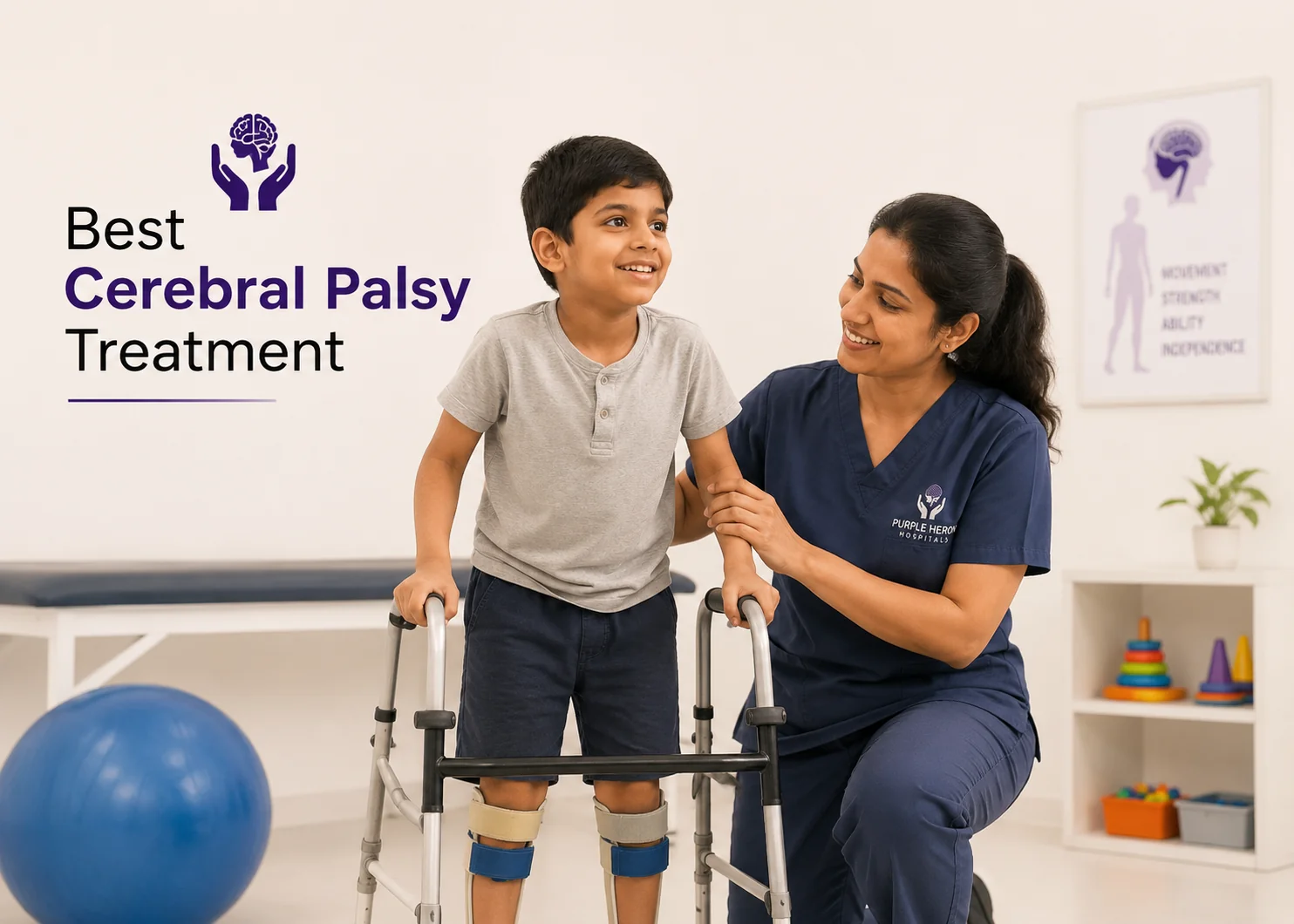
Because Every Child Deserves the Chance toMove, Grow & Thrive.
- Comprehensive Cerebral Palsy Care
- Individualized Assessment & Diagnosis
- Advanced Neurorehabilitation
- Movement & Functional Training
- Long-Term Development & Support
Cerebral Palsy is a lifelong neurological condition that can affect movement, posture, balance, coordination, and everyday function. With early intervention, personalized rehabilitation, and continuous support, children can improve their mobility, develop greater independence, and achieve a better quality of life.

Dr. Aayushi Choudhary
- MBBS
- MD (Physical Medicine & Rehabilitation) – Gold Medalist
- Fellowship in Interventional Pain Management (FIPM)
- Musculoskeletal Ultrasound (MSK USG – USPRM), Lisbon, Portugal
- President's Award 2022 European Society of Physical & Rehabilitation Medicine
Cerebral Palsy Treatment in Jaipur
Understanding Cerebral Palsy: Why We Treat Function, Not Just Form.
At Purple Heron Hospital, the first thing we want families to understand is that cerebral palsy is not simply a problem of tight muscles, abnormal legs or delayed walking. It is fundamentally a disorder of movement, posture and function arising from an injury or disturbance in the developing brain.
That distinction completely changes the way cerebral palsy should be treated.
A child may come to us because the parents notice that the legs are crossing while walking, the heels do not touch the floor, the knees remain bent, one hand is not being used normally, the child falls repeatedly, sits asymmetrically, drools excessively or has not achieved expected developmental milestones.
Cerebral palsy results from an abnormality or injury affecting the developing brain.
The brain normally coordinates an extraordinarily complex system whenever we perform even a seemingly simple task such as standing up or taking one step.
- Which muscles should activate
- At what time they should activate
- How strongly they should contract
- Which muscles should simultaneously relax
- How the trunk should balance
- How the pelvis should rotate
- Where the foot should be placed
- How the body should respond when balance shifts
In cerebral palsy, parts of this movement-control system may not function normally.
This is one of the most important concepts for every parent of a child with cerebral palsy to understand.
The original brain injury responsible for cerebral palsy is generally non-progressive. In simple terms, the damaged area of the brain is not continuously spreading year after year in the way that occurs in some progressive neurological diseases.
- The child is growing.
- The bones are getting longer.
- The muscles are being stretched across those growing bones
- The joints are developing.
- The hips are developing.
- The spine is growing.
And the child is repeating the same abnormal movement pattern thousands of times every day.
Therefore, although the neurological injury itself is relatively static, the secondary musculoskeletal consequences can progressively change during growth.
In cerebral palsy, parts of this movement-control system may not function normally.
This distinction forms the basis of cerebral palsy management.
Imagine a child whose heel lifts from the floor while walking.
- Dynamic Spasticity
- Developing Contracture
- Fixed Deformity
These three children can appear very similar while walking.
“This child is toe walking, therefore do this treatment.”
Parents often hear the word spasticity without anyone properly explaining what it means
Spasticity is classically described as a velocity-dependent increase in muscle tone associated with an upper motor neuron disorder.
The phrase sounds complicated, but the concept is easier.
Imagine slowly moving a child’s ankle upward.
The muscle may allow relatively good movement.
Spasticity can become particularly evident when the child
- Attempts to walk
- Tries to move quickly
- Becomes excited
- Loses balance
- Attempts a difficult activity
- Experiences pain, anxiety or effort
Although walking difficulty is one of the most visible manifestations, cerebral palsy may affect several functional systems.
Depending upon the location and extent of neurological involvement, children may experience difficulties involving
Spasticity can become particularly evident when the child
- Gross Motor Function Sitting, standing, transferring, walking, running, climbing stairs and maintaining balance.
- Fine Motor Function Grasping, releasing, writing, feeding, dressing and using both hands together.
- Muscle Tone Spasticity, dystonia, fluctuating tone or, in some children, reduced tone.
- Selective Motor Control A child may find it difficult to activate one specific muscle or joint without other parts of the limb moving simultaneously.
- Balance and Coordination Some children have difficulty generating rapid postural corrections when balance changes.
- Swallowing and Feeding Some children experience coughing or choking during meals, prolonged feeding times or aspiration risk.
- Drooling Excessive drooling frequently reflects difficulty coordinating swallowing and oral motor control rather than simply excessive saliva production.
- Vision Squint, visual processing difficulties and other visual abnormalities may influence mobility, learning and hand-eye coordination.
- Cognition and Learning Cognitive ability varies enormously among children with cerebral palsy.
Childhood gives us something that adulthood cannot
time before deformity becomes completely established.
During growth, muscles, tendons, bones and joints are still adapting.
This creates both a risk and an opportunity.
The risk is that prolonged abnormal forces can gradually produce fixed deformity.
The opportunity is that timely:
- Rehabilitation
- Positioning
- Strengthening
- Stretching
- Orthotic management
- Assisted standing
- Gait training
- Spasticity management
may influence how the musculoskeletal system develops.
Comprehensive Cerebral Palsy Evaluation
Before we decide what to treat, we first understand why the child moves the way they do. A movement disorder is decoded joint by joint, step by step, across the whole growing child not guessed from appearance.
A flexible deformity today can become a fixed one tomorrow
As children approach skeletal maturity, growth plates gradually close and musculoskeletal adaptations become increasingly established. Once significant structural deformity develops, conservative correction becomes far more difficult which is why cerebral palsy needs longitudinal surveillance through growth, not a single visit.
Would a straighter leg actually improve this child's life?
Function Before Form changes clinical decision-making. Two children can have the exact same-looking deformity and need entirely different plans.
A child who is functioning well
A child whose deformity is costing them
Success looks different for every child
We set goals according to each child's neurological potential, musculoskeletal condition, developmental level, environment and family priorities never toward one universal version of "normal."
What families see and what we still need to find out
Parents tell us what's visible. Our evaluation is designed to find out why it's happening and which of it actually needs treatment.
Forty questions, one connected child
History → Neurological exam → Joint-by-joint musculoskeletal exam → Gait analysis → Imaging → Synthesis every one of the 42 individual checkpoints, laid out below. Jump to a category, or just scroll tap any item to expand it.
We do not simply assess deformity. We decode movement.
Why we use standardized scales
Cerebral palsy rehabilitation should not depend on subjective descriptions. Standardized assessments help us understand what a child can do, where limitations exist, and whether treatment is creating meaningful functional change.
We don't want a child's assessment to depend on subjective phrases like "doing fairly well" or "quite stiff." Two clinicians describing the same child should reach the same description anywhere in the world.
Classification is not labelling a child
A classification such as GMFCS Level III is not a label describing the child's intelligence, personality, future worth or potential as a person. It describes one particular area of function.
Classification tells us where. Outcome measures tell us if it changed.
A classification like GMFCS Level III is not a label on a child's worth or potential it describes one area of function. It's also easy to confuse with an outcome measure, but the two do very different jobs.
Decoding Spasticity and Gait in Cerebral Palsy
Why does a child look relatively relaxed at rest but become tight the moment they try to walk? Cerebral palsy is fundamentally a disorder of movement control — the abnormality cannot always be understood on the examination couch. We need to see what happens when the nervous system is challenged to produce movement.
What is spasticity?
Spasticity is an abnormal increase in muscle tone occurring because of an injury to the pathways in the brain or spinal cord that normally regulate movement. Classically it is described as a velocity-dependent increase in resistance to passive stretch.
Slow movement
Slowly moving a child's ankle upward — it may move reasonably well.
Fast movement
Move the same ankle quickly — suddenly the calf muscle produces a catch or strong resistance.
Dynamic tone — why gait matters so much
The amount of spasticity seen in a child can change depending on:
Spasticity is not the same as muscle tightness
Parents frequently use "tight muscle," "stiffness," "spasticity" and "contracture" interchangeably — but medically these are not necessarily the same. Dynamic spasticity and fixed contracture do not require the same treatment.
Spasticity
A neurological phenomenon in which resistance increases particularly with faster stretch.
Dynamic Tightness
The limb assumes an abnormal position during activity but may remain relatively correctable when the child is relaxed.
Muscle Shortening
The muscle-tendon unit has started losing normal length.
Contracture
The muscle, tendon or surrounding tissues have structurally shortened enough that normal passive range is no longer available.
Fixed Deformity
The abnormal position persists regardless of relaxation; structural joint or skeletal changes may also have developed.
A non-progressive brain injury, but a continuously growing child
Imagine a calf muscle that is repeatedly overactive — every time the child stands or walks, it pulls the ankle downward, while the bones keep growing. If the muscle-tendon unit cannot keep pace with skeletal growth, progressive shortening can occur over years. This is why longitudinal surveillance throughout childhood is so important.
Dynamic spasticity
Reduced muscle length
Contracture
Altered joint mechanics
Fixed deformity
Secondary skeletal changes
Spasticity is not always the enemy
Seeing a tight muscle does not automatically mean "this muscle must be relaxed." Some children actually use their increased tone to compensate for weakness — stiffness around the knee may provide enough stability to help a weak child stand. If that tone is reduced without understanding its functional role, the child may become less stable.
Modified Tardieu Scale — the muscle at different velocities
The Tardieu Scale is especially useful because it examines the muscle at different movement velocities, comparing two angles.
Fast stretch — the catch angle
The angle at which a catch or resistance occurs when the limb is moved rapidly.
Slow stretch — the maximum range
The maximum passive range available when the limb is moved slowly.
Large R2–R1 difference
Suggests a significant component of the limitation may be dynamic — the muscle reacts abnormally during fast movement but still has considerable passive length. Treatment may focus on motor retraining, stretching, orthotic management, focal spasticity management, botulinum toxin in selected cases, or serial casting.
Small R2–R1 difference
May indicate that a larger component of the limitation has become structural or fixed. The question changes — whether rehabilitation alone can restore the required range, or whether the child has developed a significant contracture requiring more structural correction.
Much more than moving one foot in front of the other
Walking requires coordinated movement of every one of the following, working together at exactly the right time:
Not "the gait is abnormal" — but which part of the chain is creating it
Gait analysis is the systematic study of how a person walks. We examine:
The examination table
Tells us what movement is available.
Gait analysis
Tells us what movement the child actually uses. Both are necessary — a child may have almost normal passive ankle range but walk entirely on the toes.
Two phases, five checkpoints
Every step contains a stance phase (the foot touching the ground — the greater portion of the cycle) and a swing phase (the foot leaving the ground and moving forward). If any joint fails its role at the correct time, compensation appears elsewhere.
Initial Contact
Heel, flat foot, forefoot, toes, lateral or medial border — gives clues about ankle and foot mechanics.
Loading Response
Can the child control the knee, stabilize the ankle, maintain balance, and transfer weight smoothly?
Mid-Stance
The body moves over the supporting foot — knee, ankle, hip extension, pelvic stability and trunk compensation are examined.
Terminal Stance / Push-Off
The body moves ahead of the limb; calf function and foot mechanics become particularly important.
Swing
Enough hip flexion, knee flexion and ankle dorsiflexion are needed to clear the foot off the ground.
If the leg cannot clear the ground, the child compensates
Direct observation, from every angle, more than once
At Purple Heron Hospital, the child is observed under multiple conditions and viewed from multiple angles — because one short walk across the clinic may not represent the child's real gait.
Observed while
Viewed from
Repeated because walking changes with
Slowed down, frozen, compared — and explained to parents
Walking happens too rapidly for the human eye to appreciate every abnormality accurately. Video lets us slow it, freeze frames, compare sides, examine specific phases, compare barefoot vs. braced, and compare before and after treatment — becoming both a diagnostic and educational tool.
There is no single "cerebral palsy walk"
Different combinations of muscle overactivity, weakness, contracture, torsion and poor motor control produce different gait patterns. Explore each of the eleven patterns below.
In selected complex cases, gait can be studied beyond ordinary video
Gait Analysis Before Treatment
Before Botulinum toxin, major orthotic changes, tendon lengthening, tendon transfer, or multilevel surgery — gait analysis helps identify the true functional target. If a muscle is tight on examination but not causing functional disturbance during gait, treating it may offer little advantage. Dynamic gait may reveal an important abnormality that was not obvious on the examination table.
Gait Analysis After Treatment
The same analysis becomes valuable after treatment — far more meaningful than simply saying "the child looks better."
Decode before you correct
Our philosophy is that cerebral palsy movement should first be decoded.
A tight muscle is not a treatment plan.
An abnormal-looking gait is not a diagnosis.
And a straighter leg does not automatically mean better function.
When should cerebral palsy treatment begin and who leads the journey?
The right time to begin is not when a deformity becomes obvious. Cerebral palsy starts as a neurological problem, but as a child grows, it can gradually become a musculoskeletal one too which is why we treat the years before skeletal maturity as a window, not a waiting room.
Rehabilitation begins before a "diagnosis" ever feels certain
When an infant is identified as having cerebral palsy or is simply at high risk appropriate developmental intervention can begin immediately. We are not correcting a gait in a six-month-old; we are building the foundations it will stand on.
Neuroplasticity is doing its best work we build around it
The developing brain reorganises itself in response to repeated, active, goal-directed movement. Rehabilitation in this window favours real tasks and exploration over passive stretching strengthening the patterns most likely to serve the child for life.
Bones lengthen. Movement patterns repeat thousands of times a day.
A joint that is still flexible today can become fixed tomorrow if abnormal loading continues unchecked. This is the stage where quiet surveillance of hips, spine and feet matters as much as active treatment.
Goals change. Care doesn't stop.
As growth plates close, established deformities become harder to influence but rehabilitation, spasticity management, pain care and appropriately selected surgery continue to support function well into adulthood.
From a dynamic problem to a structural one
The same toe-walking child can sit at very different points on this line and each point calls for a different plan. Surveillance exists to catch the shift before it happens.
Dynamic equinus
The calf is overactive during standing and walking, but the ankle still moves through a good passive range when the child is relaxed.
Developing contracture
Continued abnormal loading during growth causes the muscle-tendon unit to progressively lose length. The ankle no longer sits neutral, even at rest.
Fixed structural deformity
Over time, the bone and joint structures themselves adapt. Treatment becomes more complex this is the stage early rehabilitation aims to prevent.
What we watch for before it becomes visible
The child doesn't always tell us a structural problem is developing. Some of it we have to look for.
Hip surveillance
Hip displacement can be silent in its early stages. Systematic monitoring timed by age, GMFCS level and gait pattern catches migration long before it becomes painful or difficult to manage.
Spinal alignment
Poor trunk control and asymmetric sitting can gradually shift from a flexible curve into a structural one. We track sitting symmetry, shoulder and pelvic level, and curve progression over time.
Foot & ankle
Persistent toe-walking or in-toeing can begin as a purely dynamic pattern. Regular review distinguishes what is still correctable from what is beginning to fix in place.
Rehabilitation-led, multidisciplinary care
Cerebral palsy touches the brain, muscles, joints, bones, communication and behaviour no single specialist works alone. At Purple Heron Hospital, a Pain, Musculoskeletal & Rehabilitation physician coordinates every specialist toward one functional direction.
Rehabilitation Physician
Coordinates the child's functional roadmap across every specialist.
Pediatrician
Growth, nutrition, vaccination and general child health.
Neurologist
Diagnosis, epilepsy, seizures and movement disorders.
Orthopaedic Surgeon
Structural correction contractures, hips, spine when needed.
Physiotherapy
Strength, selective movement, balance, gait and endurance.
Occupational Therapy
Hand function, feeding, dressing and everyday participation.
Orthotist
Translates gait biomechanics into the right external support.
Speech & Language
Communication, oral motor function and swallowing.
The right time is now not after a fixed deformity develops
Early assessment doesn't commit your child to any procedure. It gives your family a roadmap: for development, surveillance, rehabilitation and when truly necessary intervention.
Book a Consultation →- Delayed milestones or persistent stiffness
- Toe walking, scissoring or asymmetric sitting
- One-sided movement or hand preference
- Feeding, swallowing or drooling concerns
- A previously achieved skill becoming harder
How do we decide the right treatment for a child with cerebral palsy?
Two children with the same diagnosis can need completely different care. So instead of asking "which treatment for cerebral palsy," we ask: what exactly is preventing this particular child from functioning better?
Dynamic, or fixed?
Two children can both walk on their toes and look identical yet one has a muscle that's still fully correctable at rest, and the other has a true structural contracture. The treatment plan changes completely depending on which it is.
Is the spasticity actually harmful?
Increased tone doesn't automatically need treatment. We ask whether it's interfering with movement, comfort or hygiene and sometimes that same tone is quietly helping a weak child stand.
Spasticity, or weakness?
A "tight" muscle isn't always the story. Bent knees can come from overactive hamstrings or from weak muscles that can't hold the child upright. We look for both sides of the equation.
Primary problem, or compensation?
An outward-swinging leg may not be the disease itself it may be how the child avoids catching their foot on the ground. Remove the compensation without fixing its cause, and function can get worse.
What's happening above and below?
The body moves as one chain. An abnormal knee position can begin at the ankle or the hip so we never treat one joint without reading the whole limb.
What stage of growth is this?
A flexible deformity in a young child and an established contracture in a teenager call for very different plans. Treatment is redesigned repeatedly as the child grows never decided once.
What's the child's functional goal?
Not every child needs to walk independently for treatment to succeed. Better balance, safer assisted walking, or comfortable sitting can each be the right goal for a different child.
What does the family need most?
A clinically impressive correction that doesn't change daily life has limited value. Goals have to be child-centred, family-centred and realistic.
This is not a staircase every child must climb. A child may stay successfully managed with rehabilitation and orthotics alone; another may need focal spasticity treatment periodically; another may present for the first time needing surgical evaluation. Treatment escalates according to the problem never according to a timetable.
- Comprehensive assessment
- Functional classification
- Spasticity & contracture assessment
- Gait & movement analysis
- Identify the primary functional limitation
- Set a measurable goal
- Choose the least necessary effective intervention
- Comprehensive rehabilitation
- Reassess function and gait
- Continue surveillance through growth
We don't treat cerebral palsy to make a limb look straighter. We treat so the child can sit better, stand better, walk better where walking is the right goal, use the hands better, communicate better, participate more and feel less pain. Form should follow function not the other way around.
Conservative management active, not passive
During the growing years, "conservative" can be one of the most active phases of treatment. Tap each area below to see what it actually involves.
Medical management
We treat the whole child, not just muscle tone pain, sleep, constipation, nutrition and seizures all directly affect how a child moves and trains. Oral anti-spastic medication may help generalised tone, but the goal is never zero tone it's the amount that allows the best function.
Anti-spastic rehabilitation protocol
Medication alone doesn't teach the nervous system how to move. Once tone is managed, the child still has to learn how to activate the right muscles, shift weight, balance and use the newly available range through positioning, weight bearing, selective motor-control training and task practice, not generic stretching alone.
Stretching
Used to maintain available range and manage shortening not to force a limb into position because it "feels tight." Stretching alone doesn't correct the underlying neurological injury, and it should be prescribed for a specific muscle, not applied indiscriminately.
Strengthening
Cerebral palsy is often thought of as "tight muscles," but weak hip, knee and trunk muscles are just as common. Progressive strengthening is now a core part of rehabilitation, not something to avoid.
Positioning
What happens in the other 23 hours matters as much as therapy time. Seating, standing support and sleep positioning protect against asymmetry without immobilising the child into a "perfect posture."
Orthotics & splinting
There's no single "cerebral palsy brace." AFO, hinged AFO, ground-reaction AFO, SMO, KAFO, HKAFO and night splints each control different movement the right one comes from gait analysis, not diagnosis.
- Solid or hinged AFO controls ankle motion
- Ground-reaction AFO influences the knee via the ankle
- SMO lighter foot & ankle control
- KAFO / HKAFO for more extensive support needs
Orthotics reviewed as the child grows
There's no single "cerebral palsy brace." AFO, hinged AFO, ground-reaction AFO, SMO, KAFO, HKAFO and night splints each control different movement chosen from gait analysis, not diagnosis.
- Solid or hinged AFO controls ankle motion
- Ground-reaction AFO influences the knee via the ankle
- SMO lighter foot & ankle control
- KAFO / HKAFO for more extensive support needs
Serial casting
A prolonged, controlled stretch repositioned and reapplied over successive intervals for a muscle that's lost some range but is still modifiable. Always connected to a rehabilitation or orthotic plan afterward, never used alone.
Supported standing
Prone, supine, upright or dynamic standers give children who can't stand independently upright weight-bearing, participation and musculoskeletal loading chosen by head, trunk, hip and knee control.
Gait-assisting devices
A walker isn't a failure it's independence. The right question isn't "does the child use a device," it's "what can the child do because of it." Anterior walkers, posterior walkers, gait trainers and crutches each serve a different balance and support need.
Wheelchairs are mobility devices too
A wheelchair isn't the "end stage" of rehabilitation. A child who walks at home may still use wheeled mobility for school or long distances saving energy for learning, playing and social interaction instead of exhausting it just reaching the destination.
Footwear & the home programme
Shoe width, heel support and custom insoles complete the kinetic chain. And the home programme stays realistic a child still needs play, school and rest, not therapy every waking hour.
How do we know it's working?
Not by whether the child "looks straighter." We reassess joint range, spasticity grading, strength, GMFM, walking speed and endurance, video gait, pain, falls and participation and compare it against the goal set before treatment began.
When is conservative management enough?
If the child has useful function, acceptable range, manageable tone and no progressive deformity, there's no reason to escalate simply because another treatment exists. We escalate because the problem requires it not because we can.
Ultrasound-guided botulinum toxin not a cosmetic treatment
Botox doesn't repair the brain injury or correct a deformity. What it can do is open a temporary window reducing overactivity in one precisely identified muscle so the child can practise a more useful movement.
What does botulinum toxin actually do?
A nerve signals a muscle to contract by releasing a chemical called acetylcholine. Botulinum toxin type A temporarily interferes with that release at the treated site, so the injected muscle receives a reduced signal to contract becoming temporarily less overactive. That's the entire mechanism; it doesn't touch the brain injury itself.
Who is most likely to benefit
A child who still has useful passive range at rest but whose muscle overpowers that range during walking has the dynamic component Botox targets. A child whose joint can't reach neutral even fully relaxed has a fixed contracture, which weakening a muscle cannot restore.
Muscle selection, lower limb
- Gastrocnemius vs soleus assessed separately
- Adductor longus, brevis, magnus, gracilis
- Medial / lateral hamstrings, only if exam supports it
- Rectus femoris, in selected cases
- Tibialis posterior or anterior, by timing in gait
- Selected long toe flexors, when dynamic
Muscle selection, upper limb
The goal is never a "prettier resting hand" it's a more useful one, planned around grasp, release and bimanual function.
- Internal rotation / adduction
- Biceps, brachialis, brachioradialis
- Pronator teres, pronator quadratus
- Flexor carpi radialis / ulnaris
- Flexor digitorum superficialis / profundus
- Selected intrinsic/extrinsic thumb muscles
Why ultrasound guidance
A child's limb packs multiple small, deep muscles close to nerves, vessels, tendons and bone. Real-time ultrasound lets us see the intended muscle and guide the needle into it especially important for deep or small muscles, or when several muscle groups sit close together.
How the dose is decided
There's no single universal dose. It depends on the toxin formulation, body weight, age, number of muscles treated, target muscle size, severity of overactivity, the functional goal and prior response always within conservative, individualised, product-specific limits. Different toxin brands are not unit-equivalent. More toxin is never automatically a better result the aim is selective reduction, not maximal weakness.
The rehabilitation window after injection
The effect isn't instant, and it's temporary which is exactly why the window matters. Depending on the muscle treated, the follow-up programme may include stretching, antagonist strengthening, selective motor-control training, task-specific practice (sit-to-stand, reach, grasp), gait retraining, orthotic optimisation and serial casting where indicated. Botox without rehabilitation wastes part of the window it creates.
Safety & what to expect
Botulinum toxin type A has a long history of use in paediatric spasticity and is generally well tolerated when appropriately selected and dosed. Possible effects include injection-site discomfort, bruising or temporary local weakness; rare but important risks including swallowing or respiratory difficulty in medically vulnerable children require careful screening beforehand. Procedural distress is also addressed individually, because the child's experience matters as much as technical accuracy.
"It will paralyse my child"
The goal is selective reduction of one muscle's overactivity not paralysis. Excessive weakness is exactly what careful dose planning avoids.
"Once we start, we can never stop"
Every treatment is reassessed against its original functional goal. Further treatment happens only if a meaningful indication remains.
"Every tight muscle needs it"
Tightness can come from spasticity, dystonia, contracture or habit and only significant dynamic overactivity responds to focal toxin treatment.
"It prevents every future surgery"
It can improve function during growth, but some children still develop structural problems that need surgery later. The aim is the least necessary intervention at the right stage not a promise.
"We do not inject spasticity. We treat the functional consequence of a precisely identified muscle's abnormal activity."
Ultrasound guidance places the treatment in the intended muscle but precision starts long before the needle, with the right child, the right goal and the right movement analysis.
When surgery and botulinum toxin are used together
Not every child has a purely structural problem. Some have a fixed contracture at one level and severe dynamic spasticity at another and treating only one leaves the other still working against the child.
Structure
- Muscle-tendon units that have physically shortened
- Fixed contractures that no longer respond to tone reduction
- Bony rotation or alignment problems
Dynamic overactivity
- Muscles with good passive length but severe activity-dependent spasticity
- Overactivity that would be unnecessarily weakened by lengthening
- Forces still interfering with post-operative positioning
Types of SEMLS and surgical correction in cerebral palsy
SEMLS isn't one operation it's a customised reconstruction plan across the whole biomechanical chain, correcting only what's truly interfering with function.
Muscle-tendon lengthening
For structurally shortened units restricting joint movement.
Tendon transfer
Redirects a working muscle's force in a more useful direction.
Soft-tissue release
For fascial structures contributing to a fixed deformity.
Rotational osteotomy
Corrects femoral or tibial torsion inside the bone itself.
Foot reconstruction
Builds a stable, plantigrade, brace-compatible platform.
Hip reconstruction
For displacement or structural hip pathology.
Not all lengthening is the same
Four techniques, from the most conservative to the most corrective chosen by how much length this specific muscle actually needs.
Centre of excellence in comprehensive pediatric rehabilitation
Rehabilitation is not one hour of physiotherapy. Cerebral palsy touches movement, hands, speech, feeding, cognition and participation so the programme has to cover all of it, coordinated as one plan.
Movement & Body
Hands & Daily Life
Communication & Mind
Fitness & Participation
Progress doesn't look the same for every child and that's the point
Customized physiotherapy & anti-spastic rehabilitation
The question isn't "which exercises are good for cerebral palsy." It's which movement limitation is stopping this child from reaching the next useful functional goal and every programme starts by separating three different problems.
Spasticity
Interferes with function needs tone management, not just stretching.
Shortening
Lost muscle length needs range-preservation, orthotics or casting.
Weakness
Underneath the tightness needs strengthening and motor retraining.
Goals shift with GMFCS level not a universal walking target
Stretching what's actually the goal
Not forcing a limb into position because it "feels tight." Used to preserve hip extension, hip abduction, knee extension or ankle dorsiflexion, prevent progressive contracture, and improve orthotic tolerance always targeted to a specific muscle, never applied indiscriminately or aggressively. Painful stretching increases guarding and tone, and makes a child fearful of rehabilitation.
Prolonged positioning, beyond a few seconds of stretch
A brief manual stretch isn't always enough for a real muscle-tendon restriction. Positioning, splinting, orthoses, standing systems and serial casting all provide a longer-duration mechanical influence than hands-on stretching alone.
Strengthening chosen by the movement problem, not at random
Weak hip extensors → difficulty standing upright or rising from a chair. Trained with sit-to-stand, bridging, supported squats, step-ups.
Weak hip abductors → pelvic drop, trunk compensation, poor single-limb stability. Trained with weight shifting, side-stepping, supported single-leg activities.
Weak quadriceps → difficulty rising from sitting, knee instability, poor stairs. Trained with sit-to-stand, step-ups, controlled squatting.
Weak ankle dorsiflexors → poor foot clearance during swing. Trained with active dorsiflexion work, selective motor retraining, task-specific stepping, and in selected cases electrical stimulation or orthotic assistance.
Once strength improves, it has to be carried into standing, transfers, walking, stairs and play the difference between muscle strengthening and functional strengthening.
Anti-spastic rehabilitation, in practice
Not simply trying to "relax" every tight muscle. Combines positioning, slow range work, weight-bearing, antagonist strengthening, selective motor-control training, balance, trunk and pelvic control, repetitive functional tasks, gait training and orthotic support the focus is better movement control, not just lower tone on examination.
Antagonist strengthening
Every joint is controlled by opposing muscle groups. If the calf is overactive and the dorsiflexors are weak, that imbalance grows. After reducing excessive calf activity through rehab, positioning or Botox we deliberately train dorsiflexor activation, heel contact and controlled tibial progression. This is how tone management actually becomes function.
Selective motor control
A typically developing child can lift just the foot. A child with cerebral palsy trying to lift the foot may instead get hip flexion, knee flexion and ankle movement all firing together a whole-limb synergy. Training uses slow controlled movements, isolated joint activation, visual and tactile cueing, and repeated task practice to build more selective control.
Trunk & pelvic control come first
Limbs can't be efficiently controlled from an unstable trunk. We assess head control, sitting symmetry, pelvic stability and protective reactions, then train supported sitting, reaching outside the base of support, weight shifts and transitional movements. For some children, improving trunk control changes everything else a "leg problem" can actually be a pelvic-control problem.
Balance has three parts
Static holding a position without falling. Dynamic staying stable while moving. Reactive recovering when unexpectedly pushed. Training progresses through sitting, standing, reaching, stepping responses, direction changes and uneven surfaces, difficulty matched to the child's ability.
Transitional movements functional gold
Rolling, supine-to-sit, sit-to-stand, floor-to-stand, kneeling-to-standing, chair and bed transfers. These transitions often determine how independent a child actually is day to day. Sit-to-stand alone trains trunk control, weight shift, hip and knee extension, ankle control and balance in a single movement.
Task-specific training & neuroplasticity
The nervous system learns what it practises if the goal is walking, stairs or transfers, the child must repeatedly practise that actual task, not just isolated exercises. This repetition supports experience-dependent neuroplasticity, but the quality of practice matters: repeating an abnormal compensation thousands of times can make it more established.
Play-based rehabilitation in young children
A two-year-old shouldn't experience therapy like an adult gym session. Motor goals are built into reaching for toys, crawling games, ball play and supported stepping the therapist still targets specific movement, but the child experiences meaningful play.
Rehabilitation after Botox or structural surgery
After Botox, the window is used for available range, antagonist strengthening, selective control and gait integration teaching the child what to do with reduced spasticity. After SEMLS or structural correction, physiotherapy is redesigned around the new biomechanics: surgery changes structure, rehabilitation changes function.
Progressing the programme & measuring it
As the child improves, assistance, repetition, resistance, speed, surface, balance challenge, distance and complexity are all progressively increased supported standing may move to independent standing, then weight shifting, then stepping, then walking with assistance. Progress is confirmed with range, strength, spasticity grading, GMFM, FMS, gait video, walking speed and distance, falls and parent-reported function not simply "the child looks better."
Orthotics, splinting & biomechanical correction
An orthosis is never prescribed just because a child walks abnormally. The real question is what movement we're trying to allow, and what movement we're trying to control and that comes from gait analysis, not diagnosis.
How much ankle control does the child actually need?
From lightest support to the most restrictive chosen by the child's control, not by habit.
Static splints
Hold a joint in a relatively fixed position useful for resting alignment and range preservation.
Dynamic splints
Elastic or spring-based components allow controlled movement while assisting or correcting position.
Ground-reaction / floor-reaction AFO
Uses the ankle-ground relationship to influence knee extension during crouch gait.
Serial splinting
Correction introduced gradually, rather than forcing a joint straight all at once.
Children outgrow orthoses quickly, and comfort determines compliance a technically perfect brace the child refuses to wear has no clinical value. Fit, skin, and functional need are reassessed regularly, and orthoses are redesigned whenever Botox or surgery changes the child's biomechanics.
Assessment always comes before the brace
We study the child from pelvis → hip → knee → tibia → ankle → foot, because a problem lower down can start much higher an in-toeing foot may actually come from femoral rotation, tibial torsion or pelvic rotation. We assess passive and dynamic ankle position, knee control, hip and pelvic alignment, foot deformity, strength, spasticity, selective motor control, gait pattern and current walking-aid use, ideally with video-assisted gait analysis.
Why the same AFO can't fit every child
Two children can both walk on their toes: one has dynamic equinus with good knee control, another has equinus plus knee hyperextension, another has apparent equinus actually caused by crouch higher up. The same brace can have very different even opposite effects in each. Orthotics are biomechanical prescriptions, not off-the-shelf accessories.
AFO designs, one by one
Solid AFO substantially restricts ankle movement for strong control of equinus and alignment, but blocking the ankle too much can push compensation up to the knee or hip.
Hinged / articulated AFO allows selected movement (e.g. dorsiflexion) while restricting an unwanted direction; needs the child to have adequate knee and trunk control to use it well.
Posterior leaf-spring AFO flexible design that assists swing-phase dorsiflexion for foot clearance, without strong stance-phase control.
Ground-reaction / floor-reaction AFO uses the ankle-ground relationship to influence the knee, helpful in selected crouch patterns a good example of treating the knee through the foot.
Foot correction: hindfoot to forefoot
We assess hindfoot valgus/varus, midfoot collapse, arch, forefoot position, equinus, equinovarus, planovalgus, pressure distribution and callosities. Management may include custom foot orthoses, insoles, heel modifications, arch support, pressure redistribution and shoe modification the aim is a stable functional base, not a cosmetically straight foot. Plantar pressure assessment can reveal that two similar-looking feet actually load the ground very differently, which fine-tunes the insole and orthotic design.
Footwear & shoe raises
Custom footwear may need increased depth, modified width, heel or rocker modifications, and custom insoles to accommodate an AFO or foot deformity. A shoe raise should never be prescribed just because one leg "looks shorter" we first determine whether the discrepancy is true (an actually shorter femur or tibia) or apparent (from pelvic obliquity, hip contracture, knee flexion, equinus or scoliosis). A poorly chosen raise can worsen pelvic mechanics, so imaging such as a scanogram may be needed first.
Judged in standing and in walking not sitting
We evaluate the orthosis while the child actually stands and walks, comparing barefoot gait against gait with the device: has heel contact improved, has knee position improved, has foot clearance improved, has a new compensation appeared? Small adjustments to ankle angle, heel height or footplate "orthotic tuning" can meaningfully change how the ground-reaction force travels through the limb.
Coordinated with Botox & surgery
Once Botox reduces excessive muscle activity, the orthosis can hold or guide the limb more effectively reduce overactivity, then let the brace guide position, then retrain gait using the new opportunity. A brace built for a preoperative deformity is often no longer correct after structural correction, so the orthotist stays involved through every stage of treatment.
Growth, fit & skin
Children outgrow orthoses quickly foot length, calf circumference, pressure points and alignment all need regular review. Parents are taught to watch for redness, blisters, pressure sores or a sudden refusal to wear the brace; persistent skin damage always warrants review, and a child should never be forced to keep wearing an orthosis that's injuring them.
Compliance depends on comfort, not correction alone
A technically excellent brace the child won't wear has no clinical value. School schedule, footwear, climate and ease of putting it on all matter and we prescribe exactly when, for which activities and for how many hours it should be worn, rather than treating it as an all-day requirement by default.
Goals change with age
A young child may need an orthosis mainly to support standing and early walking. An older ambulatory child may need better gait efficiency, crouch control or sports-compatible support. A teenager may need comfort, endurance and prevention of progressive deformity the prescription evolves throughout growth rather than staying fixed.
Gait training in cerebral palsy
Two children who both "walk on their toes" can need completely different training one has dynamic equinus, another a fixed contracture, another is compensating for a proximal problem entirely. The visible pattern is only the surface.
Foot on the ground
The limb supports body weight needs hip, knee and ankle stability plus trunk balance.
Foot leaves the ground
The limb shortens to clear the floor needs hip flexion, knee flexion and ankle dorsiflexion together.
Equinus
Ankle dorsiflexion, heel contact, tibial progression.
Scissoring
Hip-abductor strength, step-width, pelvic stability.
Crouch
Hip & knee extensor strength, trunk position.
Stiff-knee
Knee-flexion practice, step-over, reciprocal timing.
Hemiplegic
Symmetric loading, affected-side weight bearing.
Why gait is different in cerebral palsy
Spasticity, weakness, poor selective motor control, contractures, rotational deformity, abnormal foot alignment, poor balance, pelvic instability and altered sensory feedback can all interfere with walking at once which is why two children who "look" the same on their toes can need entirely different training.
Gait analysis comes first
Clinical observation and video-assisted gait analysis barefoot, in usual footwear, with orthoses, with assistive devices viewed from front, back and both sides, tracing what happens from trunk to pelvis to hip to knee to ankle to foot.
Primary problem, or compensation?
A child leaning sideways may not have a "trunk problem" at all it can be hip-abductor weakness, limb-length difference or poor balance. A leg swung outward may be compensating for a knee that won't flex enough during swing. We correct the cause before trying to remove the compensation, or gait can get worse.
The gait goal isn't always "walk unaided"
Set by GMFCS level, strength, balance, contractures and environment independent walking for one child, safe walking with a posterior walker for another, good household mobility with a wheelchair for community distances for a third. The successful plan maximises meaningful mobility, not a single definition of normal.
Building blocks of a single step
- Weight transfer shifting body weight before a step is even possible
- Single-limb stability hip, knee and ankle control while standing on one leg
- Step initiation breaking a rigid whole-limb pull into coordinated flexion
- Foot clearance hip, knee and ankle working together so the limb "shortens" in swing
- Initial contact heel, flat-foot or forefoot, matched to the child's actual mechanics
- Knee control in stance different training for crouch versus recurvatum
- Pelvic & trunk control moving without collapsing or excessive leaning
- Step length, symmetry & cadence a safe, sustainable, functional speed, not simply "faster"
Training with walkers & crutches
Anterior walkers give a broad base but can encourage forward leaning; posterior walkers can encourage a more upright posture in selected ambulatory children; gait trainers add pelvic and trunk support for children working toward reciprocal stepping. Crutches suit children with enough trunk control, balance and upper-limb coordination but progression to crutches is never mandatory if a walker is safer and more efficient.
Body-weight support & treadmill practice
Body-weight-supported systems partially unload the child for repetitive stepping practice with less fear of falling, working on reciprocal gait, timing and endurance. A treadmill allows high-repetition practice of step timing and cadence at a controlled speed used when repetitive stepping serves the goal, not routinely.
Real-world training
Overground practice starting, stopping, turning, doorways, ramps, curbs because walking doesn't happen on a treadmill. Progressing to uneven surfaces (grass, slopes, obstacles), stair negotiation (two-hand support → one rail → supervision → independence), and dual-task practice such as walking while talking or carrying a bag once basic safety is established.
Endurance & efficiency
Walking ten metres in therapy doesn't mean a child can function at school. We measure and train distance, duration and fatigue, aiming for easier walking, not just more of it a child who uses less energy to move has more left for school, play and learning.
Gait retraining after Botox or structural correction
Both create a new mechanical opportunity, but the brain may keep using the old pattern. The window afterward is used to practise new foot placement, better weight shift, and reduced compensation the aim isn't to regain the old walk, but to build a new, more efficient one on the corrected biomechanics.
Feedback & technology
Video lets the child and family see foot placement, knee position and progress over time. Biofeedback from motion sensors, pressure systems or EMG makes an invisible movement error visible. Robotic gait systems can deliver high-repetition stepping with body-weight support and objective data but the team decides the gait goal, technology only serves it.
How improvement is actually measured
Not "the child is walking better," but comparison against video gait, FMS, walking speed, step length, cadence, symmetry, falls, distance and device requirement. "Walker for 50 metres" becoming "independent for 50 metres, walker only for longer distances" is a meaningful, measurable change and the programme keeps moving from the therapy floor toward the child's actual home, school and playground.
Activities of daily living & pediatric ergonomics
A child can sit beautifully and walk ten metres inside a rehabilitation centre but the real question is whether they can get out of bed, reach the bathroom, and dress themselves. That's where rehabilitation has to enter real life.
Task analysis: breaking one goal into small steps
"I want my child to dress independently" isn't one task it's sitting balance, reaching the foot, grasping the clothing, balancing while using both hands, pulling the garment up, managing buttons, and understanding the sequence. We work specifically on whichever component is actually blocking independence.
Self-feeding
Assessed through sitting position, head and trunk control, reach, grip, spoon control and hand-to-mouth coordination. Adaptations may include modified handles, non-slip surfaces, adapted cups and the right table height the goal is independent, safe completion, not doing it exactly like everyone else.
Dressing & grooming
Requires balance, range of motion, hand function, bilateral coordination and sequencing all together. A child may learn one part, then several steps, then the whole task and sometimes adapting the clothing itself is more effective than repeatedly retraining the child.
Toileting the whole pathway
Reaching the toilet, opening the door, transferring safely, sitting balance, managing clothing, cleaning, standing and leaving. A difficulty at any single step can make a child look completely dependent so the fix may be rehabilitation, environmental modification, or both.
Bathing & hygiene
Bathrooms combine slippery surfaces, transfers, small spaces and balance demands one of the hardest environments for a child with motor impairment. Grab supports, correct toilet height, bathing chairs and anti-slip surfaces progressively reduce unnecessary caregiver dependence while keeping the child safe.
Transfers the hidden key to independence
Bed-to-chair, sit-to-stand, floor-to-chair, wheelchair and vehicle transfers. For some children, independent transfers matter more than independent walking which is exactly why functional goals have to be individualised rather than defaulting to "walking" for everyone.
Home modification
A child who walks safely with a walker can still look dependent if the bathroom doorway is too narrow or the desk doesn't clear the wheelchair. We map the child's actual daily route bed → bathroom → dressing → dining → school prep → exit and ask where the environment, not the child, is creating the difficulty.
Workflow modification & reach zones
If an activity takes twenty minutes because objects are scattered across the room, the fix isn't more training it's reorganising the workflow. Frequently used items kept within easy reach, arranged in the order they're used, positioned for the child's functional hand: this reduces movement, fatigue, falls and dependence.
Training the family without creating dependence
Families naturally want to help sometimes too much, which quietly prevents a child from learning what they could partly do themselves. We teach caregivers when to assist, how much, and when to wait, deliberately stepping assistance down: maximum → moderate → minimal → supervision → independence.
Measuring ADL independence
Standardised functional measures can track self-care, mobility, transfers and participation but the most meaningful outcome stays simple: what can the child now do in everyday life that they couldn't do before?
Independence is a ladder, not a switch
Assistance is stepped down deliberately never withdrawn all at once.
Pediatric ergonomics in cerebral palsy
A child can look more disabled not because their body suddenly changed, but because a chair, a desk or a doorway was never designed for them. Ergonomics asks whether the environment is helping the child function or quietly making every activity harder.
Bedroom
Bed height, transfer space and storage reach too high blocks transfers, too low makes standing harder.
Bathroom
Door width, toilet height, grab rails and anti-slip flooring maximum privacy with minimum unnecessary help.
Dining space
Seat depth, back and foot support, table height a stable body is a better platform for hands and swallowing.
Study desk
Desk and chair height, forearm support, writing angle a "simple desk" can change function significantly.
Classroom
Space for a walker or wheelchair, position in the room, access to books participation, not the edge of the class.
Playground
Surface access, equipment reach, adaptive seating play develops strength, confidence and social skills too.
Getting into school & the school toilet
Accessibility shouldn't end at the gate steps, ramps, corridors and elevators all matter if the child actually has to use them daily. And a child who's academically capable can still stay home because the school toilet lacks door width, transfer space or grab support true inclusion needs both.
Writing ergonomics
Difficult handwriting is rarely just a hand problem trunk stability, shoulder weakness, wrist position, fatigue and even desk height can all be the real cause. Pencil grips, a sloped surface, forearm support, a keyboard or tablet: the goal is reliable access to learning, not forcing handwriting at any cost.
School bag & load management
A heavy bag can meaningfully change balance and energy in a child who already works hard to walk. Reduced weight, a trolley bag, school storage or duplicate/digital books all preserve energy for learning and play instead of just transportation.
Adaptive play
Lower play surfaces, wider pathways, supported seating, adapted cycles and modified sports equipment let the therapeutic goal and the childhood goal happen at the same time ideally alongside other children, not in a separate "special" space.
Visual & cognitive ergonomics
Ergonomics isn't only physical. Clear visual organisation, predictable object placement, reduced clutter and visual schedules can meaningfully help children with attention, executive-function or visual-perceptual difficulties navigate their day.
Assistive technology, used purposefully
Accessible switches, tablets, communication devices, adapted keyboards and environmental controls can increase independence but technology should solve a defined functional problem, not be introduced simply because it exists.
Ergonomics changes with age
A toddler's environment, a school-age child's classroom, and a teenager's need for privacy and community access are all different. Furniture height, mobility strategy and study setup are reassessed as the child grows pediatric ergonomics is an ongoing process, not a one-time fix.
Same child, different environment different mobility strategy
Cognitive rehabilitation & child development
A child who can't walk, speak clearly or point to an answer may still understand exactly what's happening around them. We never estimate intelligence from the severity of physical disability cognition is assessed separately, in ways that don't penalise the body for the brain's sake.
Attention
Sustaining, shifting, and filtering distraction affects almost every other kind of learning.
Processing speed
Understanding correctly but needing more time to plan and produce a response slow isn't the same as wrong.
Memory
Learning, retaining and recalling working memory carries multistep classroom instructions.
Executive function
Planning, organising, starting a task, changing strategy the brain's management system.
Visual-perceptual skill
Organising visual and spatial information affects reading, copying, geometry and navigation.
Language
Assessed separately as receptive (understanding) and expressive (producing) speech clarity is never a shortcut for either.
Why the assessment method itself has to be accessible
A timed pencil-and-paper test given to a child with severe hand impairment doesn't measure cognition it measures hand speed plus motor control plus cognition. Wherever possible, the assessment method is chosen to minimise the influence of motor or speech impairment on the result.
Development is more than a walking milestone
Gross motor, fine motor, language, cognition, social interaction, emotional development and adaptive function are all separate, interconnected domains. A child can be significantly delayed in one and strong in another so development is never reduced to "at what age did the child walk."
Cognitive rehabilitation, by age
For younger children: sorting, matching, puzzles, sequencing and interactive play. For older children: planning schoolwork, organising a timetable, following multistep instructions and academic problem-solving. The skill always has to transfer into everyday life not just improve inside a session.
School integration
Additional response time, alternative writing methods, keyboard or tablet use, reduced copying demands, visual schedules and rest periods where fatigue is significant. The aim isn't lowering expectations it's removing barriers that hide the child's true ability.
A team effort, led by function
Rehabilitation physician, child psychologist, neuropsychologist where needed, occupational therapist, speech-language professional, special educator and family each sees a different part of the child, integrated into one functional plan. Families extend it through conversation, reading, games and everyday choice-making, not by turning the day into therapy.
Development, across every domain
Speech & communication rehabilitation
A child who cannot speak clearly may still have a lot to say. The goal was never "make the child pronounce words better" it's giving every child the most reliable way to communicate, whether or not that route is speech.
Speech
The coordinated motor act of producing sound breathing, voice, jaw, lips, tongue, timing.
Language
Understanding and using words, sentences and meaning can be excellent even with poor speech production.
Communication
Expressing needs, thoughts, choices and personality through speech, or through another reliable route.
Dysarthria the words already exist in the brain
Dysarthria happens when neurological impairment affects the strength, speed, range or coordination of the speech muscles. The language is there; the difficulty is purely in physically producing intelligible sound an important distinction from a language or cognitive problem.
Receptive vs. expressive language, assessed separately
A child who can't verbally answer a question may still understand it completely receptive language has to be assessed independently of speech production. Expressive language is the separate question of whether the child has an efficient enough physical method to express what they already know.
Articulation, breath & voice
Articulation looks at which specific sounds are hard to produce with the tongue, lips, jaw and palate. Some children lose volume or breath partway through a sentence rehabilitation may coordinate breathing with phonation, and separately assess loudness, pitch and rate so the child communicates at the speed and volume that's clearest for them.
Communication has to work where it matters
Saying ten practised words in a session means little if the child can't ask a teacher for help or tell a friend a joke. We assess communication during real family, school and peer interaction because communication is personality, not just requests for food or water.
Behaviour is sometimes unsuccessful communication
A child who can't easily express pain, frustration or discomfort may express it through behaviour instead. Giving a more effective communication pathway can improve participation and emotional regulation, not just vocabulary.
Family & peer training
Caregivers are taught to give enough response time, avoid answering for the child, and use the communication system consistently adults often assume a delayed response means poor understanding, when it's really just more time needed to produce it. Peer communication with siblings and classmates builds social language, humour and confidence in a way adult conversation alone can't.
AAC Augmentative & Alternative Communication
We never wait indefinitely for perfect speech. AAC supports or replaces speech, and speech rehabilitation continues alongside it.
Feeding, swallowing & drooling rehabilitation
Eating coordinates posture, head control, jaw, lips, tongue, breathing and swallowing within a few seconds. A disruption anywhere in that sequence can affect safety, nutrition and comfort and it's rarely just about "chewing better."
Oral preparatory
Lip closure, chewing, bolus formation
Oral transit
Tongue moves the bolus toward the throat
Pharyngeal
Swallow triggers, airway must be protected
Esophageal
Bolus travels toward the stomach
Warning signs that need a closer look
- Coughing or choking during meals
- A wet, gurgly voice after swallowing
- Very long mealtimes or holding food in the mouth
- Recurrent chest infections or unexplained breathing difficulty while feeding
- Poor weight gain despite "eating fine"
Aspiration including the silent kind
Aspiration is food, liquid or saliva entering the airway instead of the esophagus. Coughing is the protective response but not every child coughs. Silent aspiration produces no obvious cough at all, so "the child never chokes" isn't proof that swallowing is safe. Concerning signs may warrant a videofluoroscopic swallow study (VFSS) or FEES.
Posture comes before oral-motor training
Swallowing doesn't happen independently of posture a child struggling to hold their head up has fewer resources left for precise oral coordination. Feeding rehabilitation often starts by building a stable postural base: head, trunk, pelvis and foot support, before working on lips, tongue and chewing directly.
Texture, consistency & nutrition
Different textures and liquid consistencies place different demands on swallowing safety individualised to the child's actual swallow assessment, not a blanket rule. We also track weight, hydration and calorie intake, because a child who works enormously hard to eat can still be under-nourished even when swallowing is technically possible.
Understanding drooling before treating it
Anterior drooling saliva escapes forward; visible, affects skin, clothing and social comfort. Posterior drooling saliva moves backward toward the throat; less visible, but clinically important when swallowing and airway protection are already impaired. Poor lip closure, reduced oral awareness and posture are often bigger contributors than "too much saliva."
Ultrasound-guided salivary-gland Botox
For appropriately selected children with significant drooling, botulinum toxin can be injected directly into the submandibular and/or parotid glands under ultrasound guidance reducing salivary production at the source rather than drying the whole body systemically. It reduces secretion burden; it does not repair an abnormal swallow, so it's one part of a broader strategy, not a replacement for swallowing rehabilitation.
Getting the dose right
The goal is controlled reduction, not a completely dry mouth saliva still matters for oral lubrication, dental health and digestion. Over-reduction can thicken secretions and cause discomfort, so the child's response is reassessed regularly and further treatment is decided on actual clinical need, not a fixed schedule.
Psychological, behavioural & emotional rehabilitation
Crying, refusing therapy, withdrawing or acting out is rarely just "difficult behaviour." Before trying to correct it, we ask why it's happening pain, fatigue, fear, frustration or a task that's simply too demanding.
A walking exercise the child finds frightening or exhausting begins.
The child cries and refuses to continue.
The exercise stops and crying quietly becomes an effective way to escape it.
The fix isn't forcing the activity it's asking whether the task is appropriate, painful, or simply too hard, then modifying it and rebuilding participation gradually.
Confidence & self-efficacy
Children develop an internal belief "I can do this" or "I can't do anything without help." We build the first by creating achievable challenges: one sleeve on independently, five unassisted steps, asking for water alone. Small functional victories accumulate into self-efficacy.
Learned dependence
Loving over-help can quietly erode independence a child has actually developed. Caregivers are trained to step back deliberately: doing it for the child → helping → cueing → supervising → letting the child do it alone.
Fear of falling
Even after strength and balance genuinely improve, fear from repeated falls can remain and needs its own rehabilitation progressing from highly supported movement to supervised movement to independent, real-world mobility. Confidence sometimes has to be retrained alongside the legs.
Procedure-related anxiety
Repeated casting, Botox, surgery and fittings can make medical environments themselves frightening over time. Age-appropriate preparation simple explanations, play, demonstration, visual schedules, familiar caregivers reduces unnecessary fear while still completing necessary care.
Motivation has to be meaningful, not generic
"Do five more repetitions" rarely motivates a child. Walking to the school bus, kicking a football, or using the toilet independently connecting rehabilitation to something the child actually wants changes engagement completely.
Social participation, bullying & school behaviour
Attending school isn't the same as participating in it can the child communicate with classmates, reach the playground, join games? Teasing and exclusion should be taken seriously, not met with "just be strong." And what looks like a school behaviour problem is often really a communication, ergonomic, fatigue or learning problem in disguise.
Body image & adolescence
As children approach adolescence, awareness of gait differences, orthoses, scars or a wheelchair grows and it affects confidence and participation, not just appearance. The rehabilitation conversation itself has to expand toward independence, privacy, relationships and self-management, with the adolescent increasingly making their own decisions.
Mental health & family psychology
Anxiety, depression or withdrawal should never be assumed to be "just part of cerebral palsy" they deserve the same serious assessment as physical function. And the whole family carries this: worry, financial stress, exhaustion and sibling adjustment often need their own support too.
Rehabilitation should fit into life not replace it
A child needs time to simply be a child: play, rest, make friends, be mischievous.
Upper-limb, hand & fine-motor rehabilitation
Walking gets most of the attention, but independence depends just as much on the hands reaching, holding, feeding, dressing, writing, communicating. We don't start with the fingers; hand function begins much higher up the chain.
The "hand I don't use" developmental disregard
In unilateral cerebral palsy, a child often leans so heavily on the less-affected hand that the other one even with some available movement simply stops being attempted, because the good hand is faster. Rehabilitation deliberately creates opportunities for the affected limb to participate again.
Thumb-in-palm & wrist position
A thumb pulled into the palm interferes with grasp, pinch and hygiene we first determine whether it's dynamic spasticity, muscle imbalance, or a fixed contracture, since each needs a different treatment. A persistently flexed wrist reduces the mechanical efficiency of every finger movement, so a stable wrist platform often comes before finger training.
Spasticity looks like strength it isn't
A tightly flexed arm can look powerful, but the child may have excessive activity in the flexors while the extensors are genuinely weak underneath. Reducing tone alone isn't enough the opposing, weaker muscles have to be actively strengthened and retrained too.
Selective motor control of the hand
Trying to open the fingers may instead produce wrist flexion, whole-arm movement, or shoulder elevation a difficulty isolating movement. Training progresses from large, whole-limb movement toward controlled, isolated, and finally precise functional movement.
Splinting & the Botox rehabilitation window
Splints preserve range, protect alignment or support a specific activity never just to make the hand "look straighter." When focal spasticity is significantly limiting movement, ultrasound-guided Botox to selected muscles can temporarily open a window, which is then used for antagonist strengthening, active extension, grasp-release and bimanual practice the injection creates the opportunity; rehabilitation uses it.
Handwriting and when not to insist on it
Difficult handwriting is rarely just a finger problem trunk stability, shoulder support, wrist position, fatigue and visual-motor integration all contribute. A cognitively capable child forced to demonstrate every answer by hand can be badly underestimated; a keyboard, tablet or speech-to-text system can give more accurate access to what the child actually knows.
CIMT
Constraint-Induced Movement Therapy temporarily limits the less-affected hand so the affected hand gets repeated, intensive opportunities to reach, grasp and release.
Bimanual training
Deliberately practises both hands working together opening containers, dressing, building teaching the brain to integrate the affected hand into real two-handed tasks.
Other essential domains of comprehensive rehabilitation
Depending on the child's functional level, several additional systems need attention to make sure gains made in therapy actually translate into everyday life.
Sensory & sensory-motor
Touch, proprioception and vestibular input integrated into functional movement, not stimulation for its own sake.
Vision & eye-hand coordination
Tracking, scanning and visuospatial processing assessed alongside squint or refractive concerns vision underlies both movement and learning.
Seating & 24-hour positioning
Head, trunk, pelvic and pressure management for children at higher GMFCS levels comfort, alignment and access to hands and communication together.
Assistive mobility & wheelchairs
Walking at home, a walker at school, wheels for long distances different devices for different environments, not failure.
Cardiorespiratory fitness
A child can walk but fatigue fast endurance training lets them walk far enough and long enough to actually participate.
Sports, recreation & play
Swimming, adaptive cycling and modified sports build strength and confidence while returning the child to childhood itself.
Parent & caregiver training
Safe handling, transfers and orthotic use balanced against keeping the home a home, not a 24-hour therapy centre.
Home programme
Sit-to-stand during real transfers, hand training during meals rehabilitation folded into routines that already exist.
Growth surveillance
The brain injury is non-progressive, but a growing skeleton isn't regular review catches contracture, hip or spine changes early.
Advanced technology & the future of cerebral palsy treatment
Robotics, neuromodulation and regenerative research are shifting rehabilitation from moving a child's limbs to helping the nervous system learn movement but technology doesn't replace clinical reasoning. It amplifies a well-designed programme.
Smart wheelchairs
Head, switch or touch access; shared-control navigation assists steering while the child decides the destination.
Robotic gait training
Treadmill-based systems with adjustable body-weight support for high-repetition, controlled stepping practice.
Overground exoskeletons
Wearable, joint-level assistance for real starting, stopping and turning closer to real-world walking.
Pediatric stepping devices
Supported upright stepping for children with greater mobility limitation value even without independent walking as the goal.
Upper-limb robotics
Exoskeletons and end-effector devices turn thousands of needed repetitions into an engaging, game-like task.
VR & gamified rehab
Reaching for virtual objects or controlling an avatar while genuinely practising a therapeutic movement.
Biofeedback & wearables
Makes invisible errors visible in real time, and can track movement throughout the whole day, not just one session.
FES
Functional Electrical Stimulation timed to a real movement attempt reinforcing intention, activation and feedback together.
Brain-computer interfaces
Detects movement intention directly and links it to a robotic or stimulation response still investigational in CP.
Strong foundations
- Early intervention & task-specific training
- Strengthening & gait training
- Orthotic & spasticity management
- Corrective surgery when indicated
- Communication, feeding & ADL rehab
Promising adjuncts
- Advanced robotics & exoskeletons
- Virtual-reality rehabilitation
- FES / NMES
- Wearable sensor-guided training
- Selected non-invasive neuromodulation (tDCS/TMS) under specialist protocols
Not established cures
- Stem-cell / cell-based treatment
- Exosome-based treatment
- Restorative brain-computer interfaces
- Spinal neuromodulation strategies
- Closed-loop neurostimulation, regenerative neural repair
Intrathecal baclofen pump
For a small group of children, spasticity isn't confined to one or two muscles the entire body becomes stiff enough to affect sitting, sleep, hygiene and every transfer. When rehabilitation and oral medication aren't enough, intrathecal baclofen delivers the medicine directly where it's needed, at a fraction of the oral dose.
Travels through the whole body first
Effective for many children, but higher doses needed to reach the spinal cord can bring sedation, weakness or reduced alertness along with it.
Delivered directly to the target
Reaches the cerebrospinal fluid around the spinal cord directly, so therapeutic effect is achieved with a small fraction of the equivalent oral dose.
Who may be considered
Carefully selected children and young adults with severe generalized spasticity, dystonia or a mixed pattern causing real problems painful spasms, difficult positioning, poor sleep, hard transfers despite appropriate rehabilitation and systemic medication. Many are functioning at GMFCS IV or V, but the decision is never based on GMFCS level alone; the real question is what the spasticity is preventing this specific child from doing.
The screening trial comes before any implant
A pump is never placed just because spasticity is severe. A test dose is first delivered into the intrathecal space, usually by lumbar puncture, and the team observes the change in tone, spasms, range and comfort confirming intrathecal baclofen genuinely helps before committing to a long-term implant.
Implantation is small but it's still surgery
The pump is placed under the skin, usually in the abdomen, with a thin catheter routed to the intrathecal space much smaller than major reconstructive surgery, but it still involves anaesthesia, wound healing, programming and a team experienced in long-term pump care. There's no external tube during normal use once healed.
Adjustable, not permanent
Unlike a destructive procedure, the dose can be reprogrammed externally at any time titrated up or down as spasticity, comfort, function and rehabilitation goals change, without another operation.
We don't want to remove every bit of tone
Some children actually use part of their increased tone to stand, transfer or hold a posture. Reduce it too far and the child can feel weaker, not better so the target is enough reduction to improve function, not a completely "loose" body.
The pump opens a window rehabilitation has to use it
Reducing severe tone doesn't automatically create function by itself. The new movement window is used for intensified positioning, stretching, strengthening, selective motor training, standing, transfers and in appropriately selected children gait training. The pump changes the neurological environment; rehabilitation converts that into real ability.
Can a non-walking child walk again?
The pump can't reverse brain injury, correct fixed contractures, or guarantee walking. But in children with real voluntary motor capacity being masked by excessive tone, reducing that tone can reveal movement worth training. For most children at GMFCS IV–V, success looks different: less painful spasticity, easier sitting, better sleep, easier dressing and hygiene, and lower caregiver burden all meaningful functional outcomes on their own.
Risks & why follow-up is essential
Possible complications include infection, CSF leakage, catheter blockage or migration, and pump malfunction. Sudden interruption of delivery can cause baclofen withdrawal a rapid rise in spasticity, rigidity, agitation and fever that can become a medical emergency. Families are trained to recognise warning signs, and the pump requires a structured long-term programme of refills, surveillance and eventual battery replacement never "implant it and forget it."
A few problem muscles
Targeted ultrasound-guided botulinum toxin is usually the appropriate tool.
The whole body is affected
Intrathecal baclofen becomes an important option in appropriately selected patients.
Structurally shortened tissue
Medication can't lengthen a permanently shortened tendon orthopaedic correction is required.